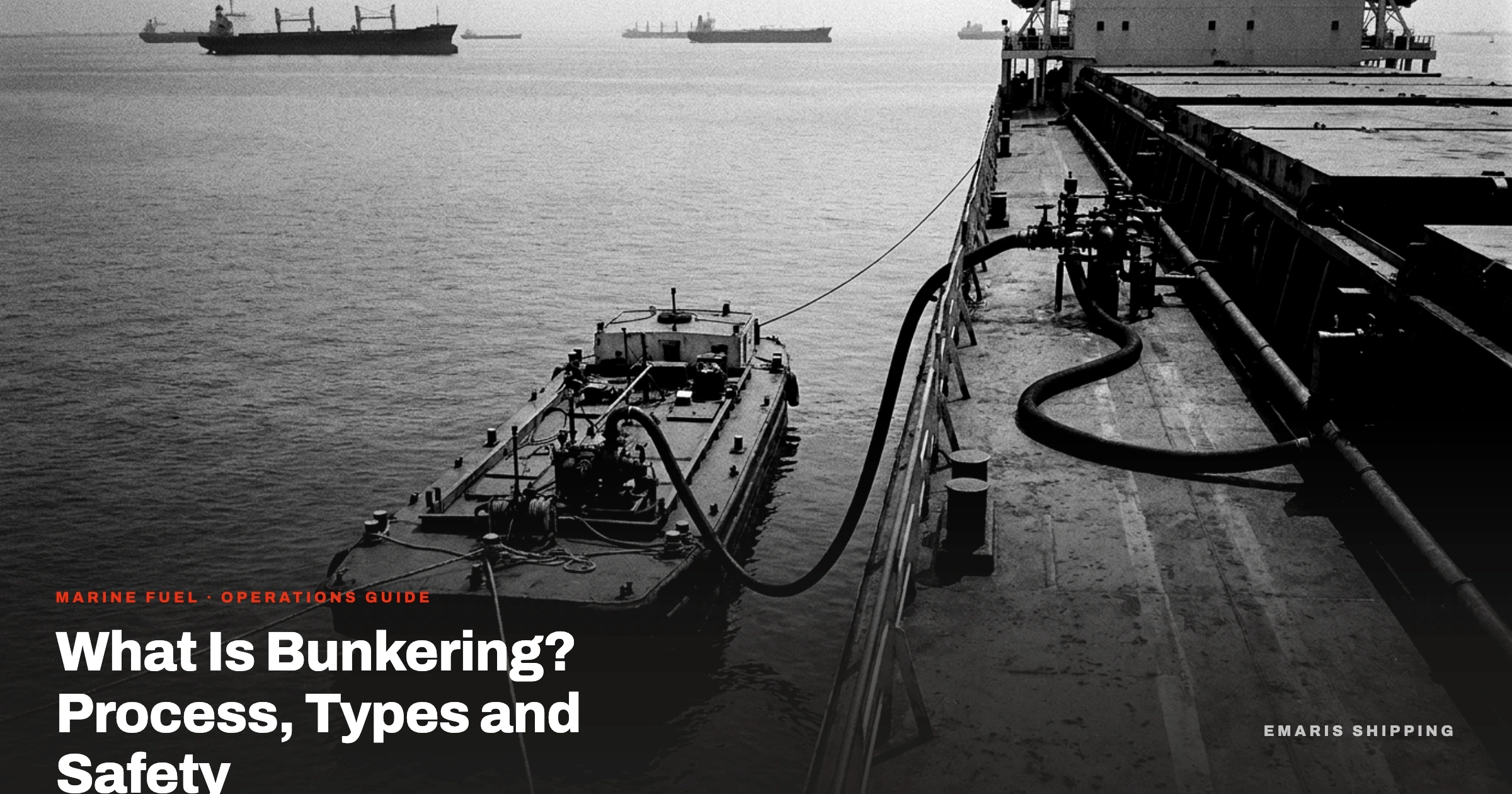
TL;DR: Bunkering is the transfer of fuel oil to a ship for its own propulsion and machinery, usually from a bunker tanker (barge) alongside, sometimes from a shore terminal or a truck. The process runs in a fixed order: pre-transfer checks and paperwork, a signed safety checklist, hose connection, continuous sampling, the metered transfer itself, then completion and sign-off on the Bunker Delivery Note (BDN). The main fuel grades are VLSFO, HSFO, MGO and LNG, each defined against the sulphur limit set by MARPOL Annex VI and the quality parameters in ISO 8217. Get the checks and the samples right before the hose is connected, and most quantity and quality disputes never happen.
Bunkering is one of the highest-risk routine operations a ship performs, and one of the most disputed commercially. A single delivery moves hundreds or thousands of tonnes of oil across a flexible hose between two vessels that are both moving. This guide explains what bunkering is, the process step by step, the fuel types you will meet, and the safety and pollution rules that govern it, for owners, operators and engineers who want the operational picture rather than a glossary entry.
What bunkering means
Bunkering is the supply and transfer of marine fuel to a ship. The word comes from the coal bunkers of early steamships, and it has stuck even though the fuel is now oil or gas. The term covers both the commercial act of buying and delivering the fuel and the physical operation of pumping it aboard and stowing it in the ship’s own tanks.
Do not confuse bunkering with cargo operations. A bunker tanker carrying fuel to sell is running a cargo operation from its side, but the receiving ship is bunkering: taking on fuel it will burn itself. That distinction matters for the paperwork, the sampling, and who carries the pollution liability. Bunker vessels sit in a category of their own, which is why Emaris treats them differently from a product tanker, a point covered in Why Bunker Fleet Management Requires a Different Approach.
Fuel reaches a ship three ways. Ship to ship from a bunker barge alongside is the most common in busy ports. Shore to ship uses a pipeline from a terminal berth. Truck to ship suits small quantities and smaller craft. The physical steps below are broadly the same whichever source you use.
The bunkering process step by step
The direct answer: bunkering follows seven stages, and the work that prevents disputes and spills happens in the first two, before any fuel moves.
1. Pre-transfer planning and documentation. The chief engineer confirms the nominated grade and quantity against the bunker order, sights the Bunker Delivery Note, and checks the fuel is specified to the right ISO 8217 grade. The receiving tanks are sounded and a stowage plan agreed so nothing overflows. Both sides exchange contact details and agree the pumping rate, the topping-off rate, and the emergency stop signal.
2. Safety checks and the bunkering checklist. A joint checklist is completed and signed by both the ship and the barge. Scuppers are plugged, drip trays are placed under the manifold, and a Ship Oil Pollution Emergency Plan (SOPEP) locker is confirmed ready. Overside valves are shut, the transfer area is roped off, and the “no smoking” and hot-work controls are enforced. This is the same discipline a vessel brings to any high-consequence operation, and it is why Vessel Technical Management: The Complete Guide treats bunkering as a managed procedure rather than a routine errand.
3. Hose connection. The bunker hose is connected to the ship’s manifold with a full set of bolts and a clean gasket, then pressure tested where required. An emergency shutdown link is agreed so either side can stop the pump fast.
4. Sampling. A continuous drip sample is drawn at the ship’s manifold from the moment fuel starts to flow, filling a set of bottles that are sealed and signed by both parties. One sealed sample, the MARPOL retained sample, stays aboard for at least twelve months. If the fuel is later challenged on sulphur or quality, that bottle is the evidence.
5. The transfer. Pumping starts slowly to prove the line is tight and going to the right tank, then builds to the agreed rate. Tank levels are watched throughout, either on the mass flow meter readout or by manual soundings on the barge. As tanks approach full, the rate is dropped for topping off to avoid an overflow.
6. Completion and line clearing. The line is blown or drained clear, the final figure is read, and valves are secured. In Singapore that final figure comes from a mass flow meter; elsewhere it may come from gauging the barge’s tanks before and after.
7. Sign-off on the Bunker Delivery Note. The BDN records the grade, the quantity, the density and the sulphur content, and both sides sign it. If the ship disputes the figure or the fuel looks off-spec, the master issues a letter of protest and notes it on the BDN before signing. Sign a clean BDN and you have accepted the delivery.
Bunker fuel types
The direct answer: four grades cover almost every delivery, and they differ mainly by sulphur content, by whether they are residual or distillate, and by what abatement the ship needs to burn them legally.
Grade | Fuel type | Typical sulphur | Main use |
|---|---|---|---|
VLSFO | Very Low Sulphur Fuel Oil (residual) | at or below 0.50% | Standard fuel for ships without a scrubber, worldwide outside ECAs |
HSFO | High Sulphur Fuel Oil (residual) | up to 3.50% | Ships fitted with an exhaust gas scrubber |
MGO | Marine Gas Oil (distillate) | at or below 0.10% | Emission Control Areas, port stays, manoeuvring, smaller craft |
LNG | Liquefied Natural Gas (cryogenic) | negligible SOx | Dual-fuel and gas-carrier newbuildings, growing in bunker hubs |
VLSFO became the workhorse fuel after 2020 because it meets the global sulphur limit without any equipment on board. HSFO is still supplied, but only a ship with a scrubber can burn it and stay compliant, since the scrubber removes the sulphur oxides from the exhaust instead of the fuel. MGO is a cleaner distillate used inside emission control areas and often during port stays. LNG is the cryogenic option: stored at around minus 162 degrees Celsius, it cuts sulphur oxides to near zero and needs a dedicated gas-handling system and crew training that a residual-fuel ship does not carry. Marine Diesel Oil (MDO) still appears as a heavier distillate blend, but those four grades shape most bunkering decisions today.
The Bunker Delivery Note and why sampling wins arguments
The direct answer: the BDN and the sealed sample are the two documents that decide every bunker dispute, so the ship controls both.
MARPOL Annex VI requires a bunker delivery note to be kept aboard for three years, recording the fuel supplied and its sulphur content, together with a representative sealed sample retained on board. Port State Control checks both. If a ship is found burning fuel over the sulphur limit, the BDN and the retained sample are what prove whether the ship or the supplier is at fault. That evidential chain is one reason vetting and inspection regimes lean on documentation, a theme picked up in SIRE 2.0 Compliance: Beyond Checklists.
Quality is measured against ISO 8217, the international specification for marine fuels. The 2024 edition, titled “Products from petroleum, synthetic and renewable sources, Fuels (class F), Specifications of marine fuels,” sets the limits for parameters such as viscosity, density, water, sulphur and catalyst fines across the distillate and residual grades. When a ship orders “VLSFO to ISO 8217,” those numbers are the contract. A fuel that fails one of them is off-spec, and the retained sample is how you show it.
Quantity is the other half of the argument. The classic scam is the “cappuccino bunker,” where air is blown into the fuel to inflate the apparent volume, so the ship pays for oil it never received. This is why some ports moved away from tank gauging toward metered delivery.
Safety and pollution prevention
The direct answer: bunkering safety rests on three things, a signed checklist, spill containment ready before the hose is connected, and full compliance with the MARPOL Annex VI sulphur cap.
Under MARPOL Annex VI, the global limit for sulphur in ships’ fuel oil has been 0.50% m/m (mass by mass) since 1 January 2020, cut from the previous 3.50%. Inside designated Emission Control Areas the limit is stricter still, at 0.10% m/m, and has been since 2015. The rule is enforced through the BDN, the retained sample, and the ship’s own fuel changeover records. You can read the current limits on the IMO’s own page for the 2020 sulphur limit, and the fuel specification itself in ISO 8217:2024.
Pollution prevention is procedural. Scuppers plugged, drip trays under the manifold, an agreed emergency stop, and a SOPEP that the crew can actually execute are what stop a small overflow becoming a reportable spill. A bunker spill in port is a detention-grade event, and how a manager prepares for and responds to one is set out in How Ship Managers Handle Emergencies and Incident Response.
Ports add their own layer. Singapore, the world’s largest bunkering hub, mandates mass flow metering under its national standard so that quantity is measured electronically rather than by eye, which closes the door on the cappuccino trick. The framework sits with the Maritime and Port Authority, whose bunkering standards govern equipment, procedures and quality across the port, and are explained further in Bunker Vessel Management and Bunkering Operations in Singapore.
A real transfer scenario
Picture a product tanker taking 800 tonnes of VLSFO from a barge alongside in an anchorage. The chief engineer sights the BDN, confirms the grade is specified to ISO 8217, and soundings show the receiving tanks can hold it with margin. The joint checklist is signed, scuppers plugged, drip trays set. Sampling starts the instant fuel flows, drip-feeding four bottles at the manifold.
Twenty minutes in, the manifold sample looks darker than expected. The engineer does not stop the transfer, but flags it, keeps the sample running, and photographs the meter readout. At completion the mass flow meter reads 788 tonnes against a BDN of 800. The master notes both the visual concern and the twelve-tonne shortfall as a letter of protest, records it on the BDN, and signs under protest. The sealed retained sample goes to the locker. The shortfall is later settled against the retained meter data. Nothing here was luck: the evidence existed because the crew built it before and during the transfer, not after the argument started.
An operator’s view
Here is the thing most owners underrate: the quantity dispute is won or lost before the hose is connected, not in the arbitration afterward. Our view is that the single highest-return investment in bunkering is not more meters or more lawyers, it is a crew drilled to sample continuously, gauge honestly, and issue a letter of protest without hesitating. A ship that samples properly and protests promptly rarely ends up in a serious claim. A ship that signs a clean BDN to avoid an awkward conversation with the barge master pays for it later, often several times over.
The second underrated point is fuel compatibility. Mixing a new VLSFO with the residue of a different batch already in the tank can cause sludge that blocks filters and, in the worst case, stalls an engine at sea. Segregate where you can, and treat a fresh grade as suspect until the sample clears. That operational judgment is a large part of what a technical manager brings, and it is closely tied to how How Ship Managers Handle PSC Inspections plays out, because fuel non-compliance is a common detention trigger.
FAQ
What is bunkering in simple terms? Bunkering is refuelling a ship. It is the transfer of marine fuel oil into a vessel’s own tanks so the ship can run its engines and machinery, usually from a bunker barge alongside.
What is a Bunker Delivery Note? The BDN is the document that records what fuel was delivered: the grade, quantity, density and sulphur content. MARPOL Annex VI requires it to be kept aboard for three years, along with a sealed representative sample, and Port State Control inspects both.
What are the main types of bunker fuel? The four common grades are VLSFO (very low sulphur residual fuel), HSFO (high sulphur residual fuel, for ships with scrubbers), MGO (a cleaner distillate for emission control areas and port stays), and LNG (a cryogenic gas fuel with near-zero sulphur oxides).
What is the sulphur limit for marine fuel? Under MARPOL Annex VI the global limit is 0.50% sulphur by mass, in force since 1 January 2020. Inside Emission Control Areas the limit is 0.10%. Ships burning high sulphur fuel must run an approved exhaust gas scrubber to comply.
What is a mass flow meter in bunkering? A mass flow meter measures the actual mass of fuel transferred electronically, rather than estimating volume by gauging tanks. Singapore mandates it under its national bunkering standard, which removes the “cappuccino bunker” air-inflation trick and settles most quantity disputes.
Why is sampling so important during bunkering? The sealed sample drawn at the ship’s manifold is the physical evidence of what was delivered. If the fuel is later challenged on sulphur or quality, that retained sample proves the ship’s case, so it must be drawn continuously from the start of the transfer and sealed by both parties.
What is a cappuccino bunker? It is a fraud where air is blown into the fuel to inflate its apparent volume, so the ship pays for oil it never received. Metered delivery and careful temperature-corrected gauging are the defences against it.
Short Q&A
We are choosing between a manager who supplies bunkering software and one who runs the operation. What is the difference? Software gives you a checklist and a dashboard. A manager gives you a crew that samples correctly, an engineer who reads a bad batch early, and someone who issues the letter of protest at three in the morning. For a high-consequence operation, the managed outcome is what protects the balance sheet.
Does the ship or the supplier carry the risk if fuel is off-spec? It depends on what the evidence shows, which is exactly why the BDN and the retained sample matter. If the ship sampled and documented properly, the burden shifts to the supplier. If the ship signed a clean BDN and lost the sample, the ship usually eats the cost.
Bunkering rewards preparation and punishes shortcuts. If you run bunker vessels or take frequent deliveries and want the process managed to this standard, from sampling discipline to MARPOL compliance, Emaris manages tanker and bunker fleets across Singapore, Southeast Asia and the Middle East. Talk to us about how we would run it on your ships.