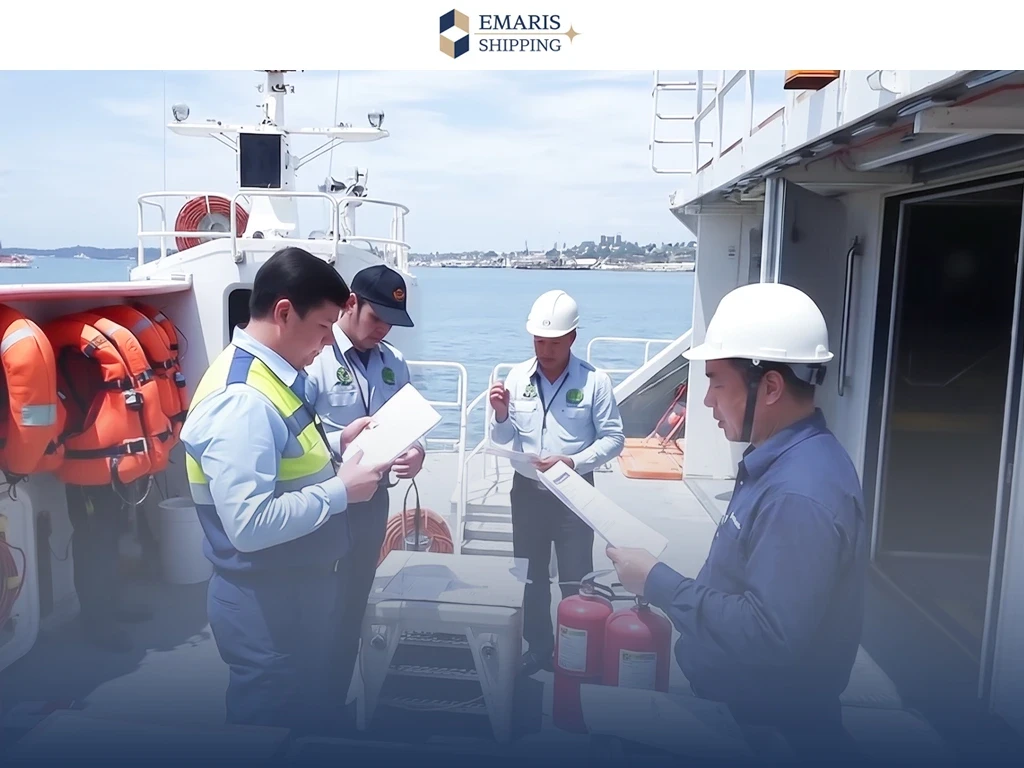
Port State Control inspections check that a visiting ship meets international safety, pollution and crewing rules. Ship managers reduce detention risk by treating PSC readiness as a daily state, closing ISM non-conformities fast, keeping certificates and MARPOL records current, and rehearsing the deficiencies inspectors flag most.
A Port State Control inspection is one of the most consequential events in a vessel's operational year. A detention can mean lost charter revenue of $30,000 to $150,000 per day, reputational damage with charterers, and SIRE consequences for tanker operators that take months to recover from. How a ship management company prepares for, manages during, and responds to a PSC inspection reveals more about their operational standards than any marketing claim.
This guide covers what ship owners and fleet managers need to understand about the PSC inspection process, and how a competent ship manager should be handling it on your behalf.
What Is a Port State Control Inspection?
Port State Control is the inspection of foreign-flagged vessels calling at national ports to verify compliance with international maritime conventions. The authority to conduct PSC inspections is held by the port state, the country whose port the vessel is visiting, and operates independently of the vessel's Flag State.
PSC is administered regionally through a network of Memoranda of Understanding (MOUs). The three most commercially significant for deep-sea trades are:
Paris MOU: Covers European and North Atlantic ports. Member states include the UK, the Netherlands, France, Germany, and most EU maritime nations. A poor performance record under Paris MOU affects trading across the entire North Atlantic and European range.
Tokyo MOU: Covers the Asia-Pacific region, including Singapore, China, Japan, South Korea, Australia, and key Southeast Asian ports. For vessels trading on Asia routes, the majority of global dry bulk and tanker traffic, Tokyo MOU inspection history is the primary PSC record of consequence.
USCG (United States Coast Guard): The US operates its own PSC regime independently of the MOU framework. USCG inspections are known for thoroughness and the consequences of detention under USCG include severe restrictions on future US port access.
PSC Officers (PSCOs) inspect vessels against the requirements of the core international maritime conventions: SOLAS (safety equipment, fire systems, watertight integrity, lifesaving appliances), MARPOL (pollution prevention, Oil Record Book entries, garbage management plans), STCW (officer and crew certification, rest hours), MLC 2006 (seafarer living conditions, wages, medical care), and the ISM Code (safety management system implementation).
Vessels are selected for inspection based on a risk-based targeting system. Factors that increase inspection probability include: Flag State performance (certain flag registries carry a higher inspection rate due to historical deficiency records), previous PSC deficiencies and detentions, vessel age, and time since last inspection. Vessels with a poor inspection history are flagged for expanded inspections, a more intensive process that covers all convention areas, not just a targeted spot check.
The Paris MOU and Tokyo MOU also conduct annual Concentrated Inspection Campaigns (CICs) focused on a specific theme; recent examples have targeted MLC 2006 crew welfare compliance and STCW rest hours. During a CIC period, all vessels calling at member ports face a focused inspection element regardless of their usual risk profile.
How Ship Managers Prepare for PSC Inspections
Reactive management of PSC, addressing deficiencies only when a PSCO is on the gangway, is not management at all. A competent ship manager runs a continuous preparation cycle.
The foundation is a functioning ISM safety management system. ISM Code compliance goes well beyond having an SMS manual on board and requires demonstrable implementation: regular internal audits, corrective action tracking, drill records, near-miss reporting, and management review meetings. A PSCO reviewing an SMS manual that clearly has not been used in day-to-day operations will probe further. A well-maintained ISM system produces the documentation that inspections require without scrambling.
Pre-arrival preparation for high-inspection-risk ports is standard practice for a quality manager. This involves:
Verifying all SOLAS equipment certificates are current: liferaft servicing, EPIRB registration and hydrostatic release, fire detection system maintenance records, immersion suit inspection records.
Confirming STCW certificates for all officers and ratings are valid and correctly endorsed for the vessel type and trade area.
Reviewing ISM logbooks for completeness: drill records, safety committee meeting minutes, corrective action logs.
Ensuring MARPOL Oil Record Book (ORB) entries are up to date and accurately reflect all machinery space operations.
Checking that ISPS (International Ship and Port Facility Security Code) documentation is in order, including the Ship Security Plan and the most recent ISPS verification.
Confirming MLC 2006 documentation: seafarer employment agreements, wage payment records, and medical certificate validity for all crew.
Pre-PSC audit preparation is a specialised function. Our marine audit services are designed to identify documentation gaps and compliance deficiencies before a PSCO does, giving the management team time to address them under controlled conditions rather than under inspection pressure.

What Happens During a PSC Inspection
A PSC inspection begins when the PSCO boards the vessel, typically at pilot boarding or shortly after berthing. The initial boarding phase focuses on documentation review. The master must be prepared to produce, without delay:
ISM documentation: the Document of Compliance (DOC) for the company and the Safety Management Certificate (SMC) for the vessel.
SOLAS certificates: Cargo Ship Safety Equipment Certificate, Cargo Ship Safety Construction Certificate, SOLAS training records, and drill documentation.
MARPOL certificates: International Oil Pollution Prevention Certificate (IOPPC), International Air Pollution Prevention Certificate (IAPPC) for vessels subject to Annex VI, Oil Record Book, and garbage management plan.
STCW certificates for all officers, watch-keepers, and ratings in safety-critical roles.
MLC 2006 Maritime Labour Certificate and the vessel's Declaration of Maritime Labour Compliance (DMLC) Parts I and II.
ISM checklists and maintenance records relevant to safety-critical equipment.
Following the documentation review, the PSCO will conduct a physical inspection of the vessel. The scope of the physical inspection depends on the outcome of the initial check and the vessel's risk profile. Areas routinely inspected include: lifeboat and rescue boat launching equipment, fire detection and suppression systems, bilge systems, engine room condition and oil-water separator operability, crew accommodation conditions under MLC 2006.
Throughout the inspection, the ship manager's shore team must be immediately reachable. A PSCO who cannot get a response from the shore-side management contact within a reasonable time will record that fact. In a marginal inspection, where the PSCO is deciding whether to issue a deficiency notice or escalate to detention, the responsiveness and technical competence of the shore team can be the deciding factor.
If deficiencies are noted, the PSCO will issue a deficiency report specifying each item, the relevant convention, and the required rectification. Minor deficiencies can typically be rectified before departure with PSCO confirmation. Serious deficiencies that affect vessel safety or seaworthiness, or that indicate a systemic ISM failure, will result in detention.
The Most Common PSC Deficiencies, and How Managers Prevent Them
PSC deficiency data from the Tokyo MOU 2024 annual report provides a clear picture of where inspection failures concentrate:
Fire safety equipment (approximately 18% of deficiencies): Fire detection system faults, extinguisher and fixed fire-fighting system maintenance gaps, fire door deficiencies.
ISM and documentation (approximately 15%): Incomplete or outdated SMS documentation, missing drill records, corrective action tracking failures.
Safety in general (approximately 13%): Unsafe conditions in machinery spaces, deck equipment deficiencies, guard and railing failures.
Crew certification and manning (approximately 11%): Invalid STCW certificates, incorrect endorsements, rest hour violations, watch-keeping arrangement deficiencies.
MARPOL compliance (approximately 9%): Oil Record Book entry gaps, oily water separator faults, garbage management plan implementation failures.
What this data makes clear is that documentation and ISM system failures are among the most prevalent deficiency categories, and they are the most avoidable. A fire detection system fault may involve equipment failure that is genuinely difficult to predict. An incomplete drill record or an ISM corrective action log that has not been updated in six months reflects a management discipline failure, not an equipment failure.
A competent ship manager closes documentation gaps before inspections through systematic pre-arrival auditing, regular ISM internal audits at the planned intervals required by the ISM Code itself, and integrated PMS oversight that links equipment maintenance records to certification status. When these systems are functioning correctly, the overwhelming majority of documentation deficiencies simply do not arise.
How a Ship Manager Responds to a PSC Detention
A detention is a serious commercial and operational event. The vessel cannot sail until the detaining PSCO is satisfied that the specified deficiencies have been rectified, or, in some cases, until the vessel proceeds to a designated port for repair with PSCO approval. During that period, the vessel generates no revenue while port costs, crew costs, and charter party obligations continue.
The immediate sequence when a detention is issued:
The ship manager notifies the owner, the vessel's Flag State administration, and the Classification Society immediately. All three have formal obligations and rights in the detention process.
The manager assesses the specific deficiencies cited and determines whether rectification can be completed at the current port or requires a port of repair.
A Corrective Action Plan (CAP) is produced, typically required within 24 to 72 hours, specifying how each cited deficiency will be addressed, the timeline, and the responsible party.
The Flag State administration is engaged to support the rectification process and liaise with the PSCO where appropriate. A ship manager with established relationships with the relevant Flag State administration can expedite this engagement considerably.
The Classification Society may need to survey rectified items before the PSCO will accept them as cleared, particularly for structural or machinery deficiencies.
Beyond the immediate rectification, a detention triggers a mandatory root-cause analysis within the ISM system. The ISM Code requires that significant deficiencies generate a corrective action that addresses the underlying cause, not just the specific item cited. A manager who treats a detention as paperwork to be cleared, instead of an ISM system event that needs genuine analysis, will face repeat detentions.
The detention is also recorded in the Paris MOU and Tokyo MOU databases and will be visible to future PSCOs for years. How the manager responds to the incident investigation and the quality of the corrective action submitted influence how the vessel's risk profile is assessed in subsequent port calls.
Reducing PSC Risk: The Emaris Approach
Emaris Shipping manages PSC risk as an integrated element of fleet operations, not as a reactive compliance function. Our ship management services are built around an ISM-certified management system that maintains audit-readiness as a permanent operational standard, not a pre-inspection sprint.
Our approach to PSC risk reduction involves several integrated elements:
Pre-arrival PSC screening: Before vessels call at ports with elevated inspection rates under Paris MOU or Tokyo MOU, our shore team conducts a pre-arrival documentation and certification review. Gaps are identified and addressed before the PSCO boards.
Active ISM system management: Our ISM internal audit schedule is maintained at the intervals required by the Code, with corrective actions tracked to closure. We do not allow corrective action backlogs to accumulate between audits.
STCW certification tracking: Officer and crew certificates are tracked centrally against their validity dates. Certificate renewals are initiated well in advance, with no tolerance for serving crew with lapsed or incorrectly endorsed certificates.
Integrated PMS-to-certification linkage: Safety-critical equipment maintenance records are maintained in the PMS with direct linkage to the relevant SOLAS certificates. When a servicing interval is approaching, the system triggers the work order and the certificate renewal simultaneously.
Shore team availability: Our operations team is reachable around the clock during vessel calls at high-inspection-risk ports. A PSCO inquiry gets a competent, informed response, not a message to call back during business hours.
Singapore-based operations give Emaris direct working relationships with the Maritime and Port Authority of Singapore (MPA), major Classification Societies including Lloyd's Register, DNV, and Bureau Veritas, and the Flag State administrations most relevant to our managed fleet. Those relationships matter when a detention needs to be resolved under time pressure.
Marine Audits as a Pre-PSC Tool
The most effective way to manage PSC risk is to identify and close deficiencies before an inspection takes place. A structured pre-PSC internal audit, conducted by qualified marine auditors who know what PSCOs are specifically looking for in the current inspection environment, is the most reliable tool available for this purpose.
A pre-PSC audit differs from an ISM internal audit in its focus. Where an ISM internal audit assesses the overall functioning of the safety management system, a pre-PSC audit simulates the inspection process, following the actual checklist priorities of the relevant MOU, checking documentation against the current CIC theme if applicable, and testing crew knowledge of emergency procedures in the way a PSCO would.
For tanker operators subject to SIRE (Ship Inspection Report Programme) vetting, the pre-inspection audit serves a dual purpose: addressing PSC exposure while simultaneously preparing for SIRE inspections by oil major charterers. SIRE and CDI vetting share significant overlap with PSC in documentation and equipment requirements, and a vessel that is SIRE-ready is typically PSC-ready.
Emaris provides marine audits as a standalone service available to owners regardless of whether Emaris holds the full management mandate. If you are operating under a technical-only arrangement and want independent pre-PSC audit coverage, or if you are preparing for a SIRE vetting cycle, contact us to discuss an audit programme structured around your trading pattern and port call schedule.
PSC performance is ultimately a direct measure of operational standards. Owners and fleet managers who want an honest assessment of where their vessels stand, and a management partner with the systems and expertise to improve that standing, should engage with their ship manager on the basis of inspection records, corrective action rates, and pre-inspection audit results. Those are the numbers that matter.