
Ten years ago, a technical manager's visibility into a vessel's operational state depended entirely on what the Chief Engineer chose to report. Today, digital monitoring systems installed on vessels can transmit engine performance data, fuel consumption figures, equipment fault codes, and environmental compliance readings to shore in near real-time, without requiring any intervention from the crew.
Remote vessel monitoring is not a future capability; it is being deployed by progressive ship management companies now, and the performance differential between managed fleets using it and those that are not is widening.
This article explains what remote vessel monitoring covers, how it changes the technical manager's job, and what ship owners should expect from a management partner who has genuinely integrated digital monitoring into their operations.
What is Remote Vessel Monitoring?
Remote vessel monitoring is the collection, transmission, and analysis of shipboard data from shore, typically via satellite or cellular communication, to provide technical managers and fleet operators with real-time or near-real-time visibility into vessel performance and system condition.
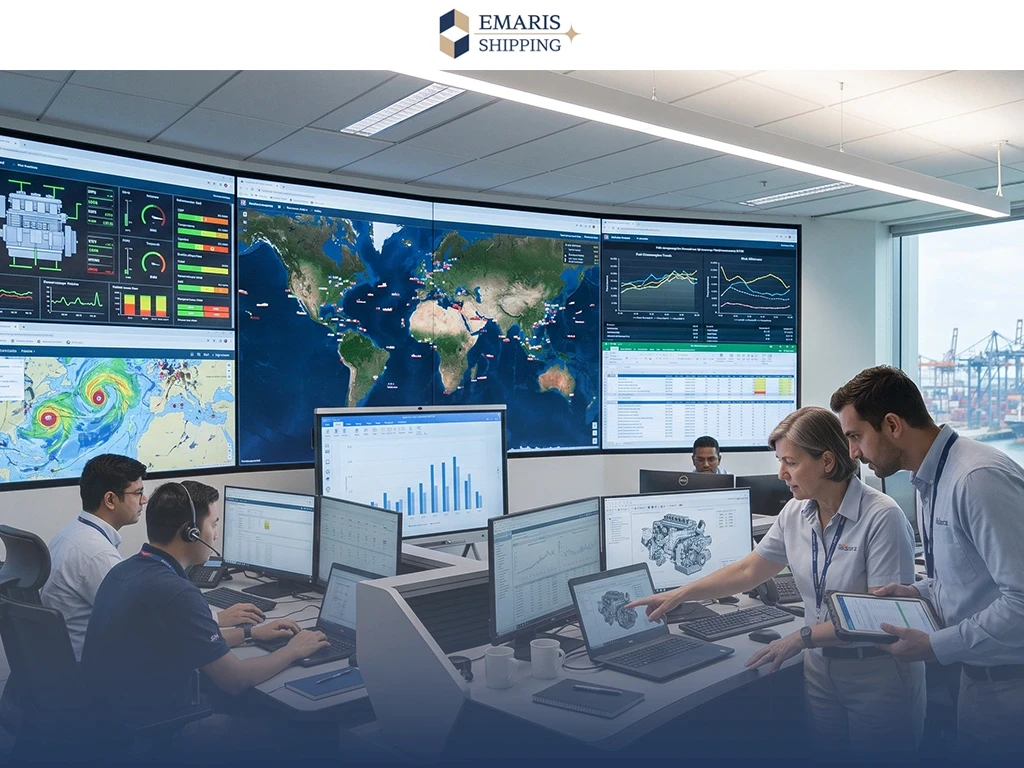
Modern monitoring systems use a combination of shipboard sensors, data loggers, and IoT gateways to capture data from engine management systems, environmental monitoring equipment, navigation systems, and auxiliary machinery. This data is transmitted to shore-based platforms where it is processed and presented to technical managers through dashboards and alert systems.
The scope of what can be monitored remotely has expanded significantly as sensor technology has matured:
Main engine performance, cylinder temperatures, exhaust gas temperatures, fuel rack positions, turbocharger speeds
Fuel consumption and efficiency, real-time consumption versus charter party performance standards
Environmental compliance, sulphur content monitoring for MARPOL Annex VI compliance, NOx monitoring in ECAs
Navigational data, position, speed over ground, heading, weather data
Auxiliary systems, generator load, bilge high-level alarms, refrigeration systems for reefer vessels
Structural monitoring, hull stress sensors on larger vessels in heavy weather trades
Data Sources: Where Remote Monitoring Data Comes From
The data flowing into a remote monitoring platform comes from multiple shipboard sources, which is why system integration is a significant technical challenge:
Engine Management Systems (EMS)
Modern main engines (MAN, Wärtsilä, Yanmar) are equipped with proprietary engine management systems that continuously monitor hundreds of operating parameters. Remote monitoring platforms access this data through dedicated gateways that interface with the EMS without disrupting its primary function.
Environmental Monitoring Equipment
MARPOL compliance monitoring devices, including fuel flow meters, Exhaust Gas Cleaning System (EGCS/scrubber) monitoring units, and ozone depletion substance detectors, generate compliance data that can be transmitted directly to shore and cross-referenced against the vessel's oil record book and fuel oil record book.
Mass Flow Meters (MFM)
For vessels operating in Singapore's bunker market, mass flow meters are mandatory for all bunker operations under MPA regulations. MFM data can be integrated into remote monitoring systems to provide real-time visibility into bunker transfer operations, a significant compliance and commercial benefit for bunker fleet operators.
AIS and Navigation Data
Vessel position, speed, and heading data from AIS is widely available through commercial data providers, enabling technical managers to track fleet movements without requiring vessel-specific hardware. AIS data combined with weather routing data enables performance benchmarking against expected speed and consumption curves.
Alert Systems: The Move from Reactive to Proactive Maintenance
The transformative impact of remote vessel monitoring lies in alert management. Traditional ship management operates on a reporting model: the Chief Engineer identifies a problem and reports it to the technical manager ashore. This is inherently reactive, the problem must already be developing before it enters the management loop.
Remote monitoring alert systems reverse this dynamic. By establishing parameter thresholds for critical machinery systems, alert platforms notify technical managers when a parameter begins to deviate from its normal operating range, often before the deviation reaches a level that the crew would consider reportable.
Example: Main Engine Temperature Deviation
A gradual increase in one cylinder's exhaust gas temperature (EGT), within normal limits at any individual reading, can indicate developing fuel injector wear or combustion inefficiency if tracked as a trend over 72 hours. A remote monitoring alert set to flag EGT trend deviation of more than 10°C over 72 hours would surface this issue days before it becomes a reportable defect, giving the technical manager time to arrange an early inspection and parts procurement without an unplanned stoppage.
This shift from reactive defect management to proactive alert response is the core value proposition of remote monitoring for technical managers.
Predictive Maintenance: Moving Beyond Planned Schedules
Traditional planned maintenance systems operate on fixed intervals, a job is scheduled every X hours or every Y months based on manufacturer recommendations. This approach is reliable but inefficient: it results in unnecessary maintenance of healthy systems and sometimes misses developing faults in systems that are deteriorating faster than the standard interval assumes.
Remote monitoring enables condition-based maintenance, maintenance triggered by the actual condition of a system rather than elapsed time. This approach:
Reduces maintenance costs by avoiding unnecessary planned jobs on systems operating within normal parameters
Reduces unplanned breakdowns by identifying developing faults before they cause operational failure
Optimises dry dock scope by providing data-evidenced machinery condition assessments that justify extending (or shortening) planned intervals based on actual performance
For tanker operators subject to SIRE 2.0 vetting, the ability to demonstrate a data-driven maintenance programme is increasingly relevant. SIRE 2.0 inspectors assess whether maintenance practices are evidence-based, a remote monitoring programme provides exactly this evidence.
Compliance Monitoring: Digital Evidence for Regulatory Requirements
One of the most commercially significant benefits of remote vessel monitoring is the generation of digital compliance evidence, records that are timestamped, tamper-resistant, and far more reliable as regulatory evidence than manual log entries.
For MARPOL compliance, this means:
Automatic generation of fuel oil record book data from MFM systems, reducing the administrative burden on the Chief Engineer and eliminating manual entry errors
EGCS/scrubber monitoring data that can be submitted electronically to port state authorities
NOx monitoring records for vessels operating in NOx ECAs under MARPOL Annex VI Tier III requirements
For ISM compliance, digital monitoring platforms provide:
Automatically timestamped maintenance completion records
Audit trails for safety-critical system checks (fire detection tests, LSA equipment checks)
Crew drill records with timestamps
The evidential quality of digitally generated compliance records, compared to handwritten log entries subject to errors and retrospective amendment, is increasingly recognised by classification societies and flag state administrators.
EmarisOne: Emaris Shipping's Approach to Remote Monitoring and Digital Compliance
At Emaris Shipping, our digital compliance and operational management is built around our proprietary platform, EmarisOne, which integrates vessel monitoring data, compliance tracking, and procurement management into a single operational intelligence environment.
For vessels under our management, EmarisOne provides:
Real-time visibility into vessel operational data accessible by our shore-based technical team and by ship owners via authorised access
Automated compliance tracking, statutory certificate expiry monitoring, PMS job tracking, and deficiency management linked to corrective action workflows
Digital procurement records linked to maintenance jobs, providing a complete audit trail from PMS trigger to part delivery
Reporting dashboards that give owners a current operational status view without waiting for the next scheduled management report
Our digital compliance and operational systems service is available to ship owners who want to combine Emaris's technical management expertise with the operational transparency that digital monitoring provides.
The Future of Remote Vessel Monitoring
The evolution of remote monitoring is accelerating in 2026, driven by three converging trends:
AI-powered predictive analytics, moving beyond threshold alerts to machine learning models that detect early anomaly signatures in multi-variable datasets, enabling even earlier identification of developing faults than current generation systems.
Decarbonisation compliance integration, CII (Carbon Intensity Indicator) monitoring and reporting under MARPOL Annex VI are increasingly integrated into remote monitoring platforms, enabling technical managers to track real-time CII performance and intervene (through speed optimisation, routing adjustments, or maintenance actions) to protect the vessel's annual CII rating.
Autonomous vessel monitoring, as autonomous and semi-autonomous vessel technology matures, remote monitoring becomes the primary management interface, no longer a supplementary oversight tool. The technical management competencies being built around remote monitoring today are the foundation for the next generation of maritime operations.
Frequently Asked Questions
What is the cost of implementing remote vessel monitoring?
Costs vary significantly depending on the scope of the monitoring system and the connectivity solution used. Basic position and AIS-based monitoring can be implemented at low cost using commercial maritime data providers. Full onboard monitoring with sensor integration and satellite connectivity typically requires a capital investment in onboard hardware plus ongoing connectivity and platform subscription fees. For most managed vessels, the payback period from reduced unplanned maintenance costs is measured in months to a few years.
Can remote monitoring data be used in PSC inspections?
Digital monitoring data can be provided to PSC inspectors as supplementary evidence of maintenance compliance, though inspectors are not required to accept it as a substitute for required logbooks. Where remote monitoring integrates directly with oil record book or fuel oil record book generation (via MFM systems), the data carries formal regulatory standing.
What communication technology is used for vessel data transmission?
Most remote monitoring systems use satellite communication, L-band (VSAT or Iridium) or VSAT, for high-volume data transmission. AIS data uses VHF/satellite AIS infrastructure. For vessels trading in coastal areas or port environments, cellular 4G/5G connectivity is increasingly used as a lower-cost alternative.
External Sources: