
A ship owner who cannot read their vessel's operating budget cannot hold their technical manager accountable. Yet this is more common than the industry tends to acknowledge, ship owners who are sophisticated investors or experienced operators in other industries sometimes lack familiarity with the nine-line OPEX framework that professional ship managers use to structure vessel budgets.
This guide demystifies the annual operating budget for technical ship management: what the standard cost categories mean, what drives each line, how OPEX relates to CAPEX, and what a ship owner should ask their manager when reviewing the budget for the coming year.
OPEX vs CAPEX: Understanding the Distinction
The starting point for any ship management budget discussion is the distinction between Operating Expenditure (OPEX) and Capital Expenditure (CAPEX).
OPEX, Operating Expenditure, covers the ongoing costs of running the vessel day to day. These are recurring expenses: crew wages, insurance, maintenance, spares, management fees. OPEX is what it costs to keep the vessel in service, compliant, and commercially available. It is typically expressed as a daily rate (daily OPEX) or an annual total.
CAPEX, Capital Expenditure, covers major one-time or periodic investments that extend or improve the vessel's asset value or operating capacity. In ship management, the most significant CAPEX items are major structural repairs, engine overhauls beyond the scope of routine maintenance, and significant equipment upgrades (ECDIS installation, scrubber retrofitting, ballast water treatment systems). CAPEX items are typically handled outside the annual operating budget and require separate owner approval.
The grey area between OPEX and CAPEX, where planned maintenance jobs expand into scope that crosses the CAPEX threshold, is a common area of dispute between ship owners and managers. A well-structured management agreement defines the approval threshold clearly.
Manning Costs: The Largest OPEX Line
For most vessel types, crew wages and associated manning costs represent 35–45% of total daily OPEX. This makes it the single most important line in the operating budget and the one that requires the most careful management.
Manning costs include:
Officer and rating salaries, the all-in monthly cost per rank, including the basic wage component and any productivity, watchkeeping, or seniority allowances defined in the Collective Bargaining Agreement (CBA)
Crew travel and repatriation, flights for crew changes, typically budgeted per rotation
Medical expenses, pre-employment medicals (PEM), medical treatment costs incurred during service, and MLC-mandated sick pay coverage
Crew training, STCW refresher courses, tanker endorsements, safety training
P&I and MLC insurance, crew liability coverage under the P&I club entry
Manning costs are strongly influenced by the nationality of crew (Indonesian, Filipino, and Indian crew are typically more cost-effective than European nationals for officer ranks), the vessel's trading area (vessels in high-risk areas carry a war bonus), and the applicable CBA (ITF-approved CBAs set minimum wage standards).
Maintenance Budget: Planned vs Unplanned Provision
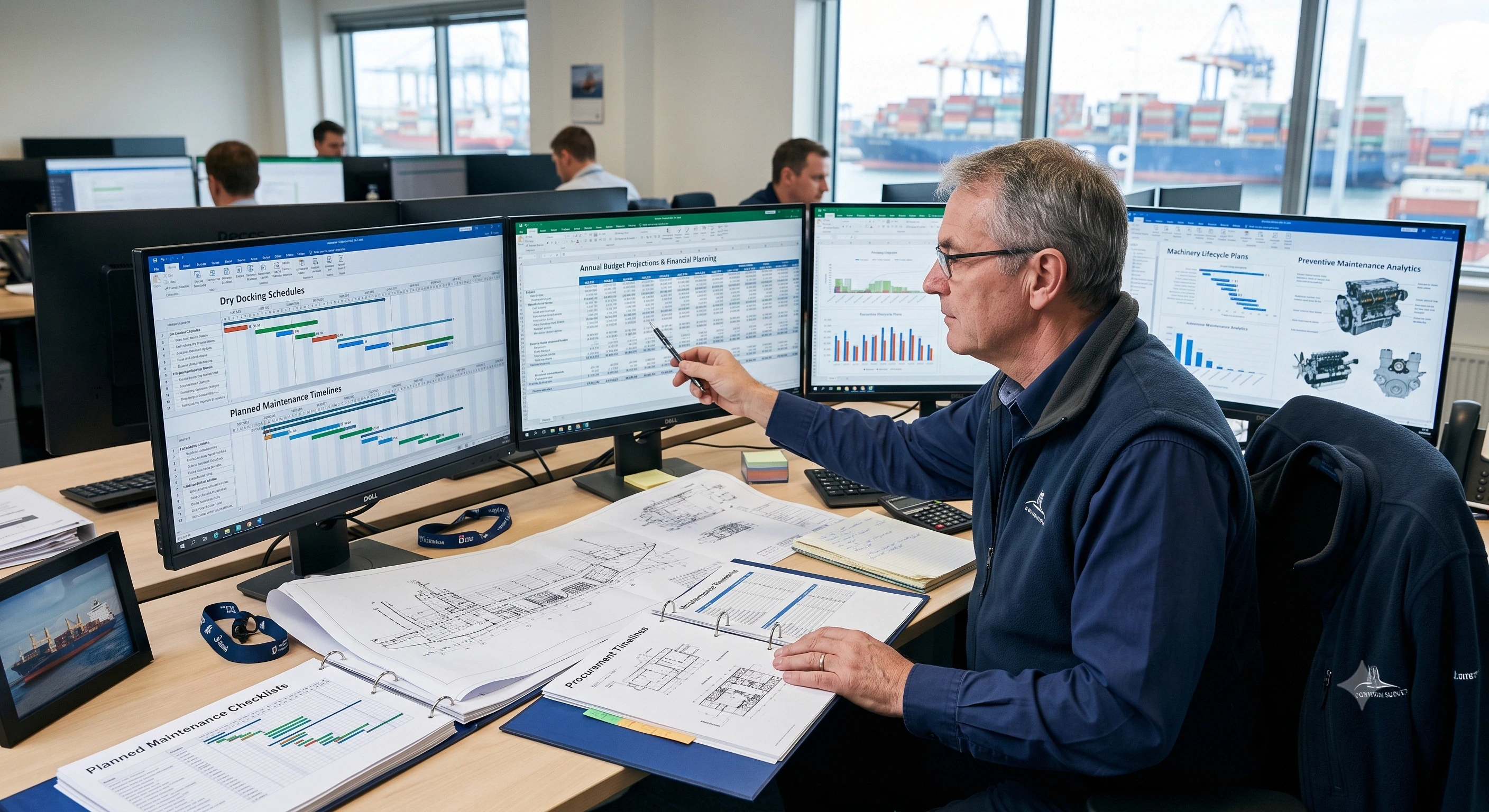
The maintenance budget covers all materials, labour, and services required to maintain the vessel's mechanical and structural condition. It is structured around two components:
Planned Maintenance (Routine OPEX)
Covers the cost of PMS-scheduled jobs: oil changes, filter replacements, pump overhauls, safety equipment services, and routine class-required maintenance. This portion is relatively predictable based on the vessel's planned maintenance schedule and can be budgeted accurately by an experienced technical manager.
Unplanned Maintenance Provision
Covers defects that arise outside the planned schedule, unforeseen breakdowns, weather damage, accelerated wear on a specific component. Technical managers typically budget a contingency provision of 10–15% of the planned maintenance budget for unplanned items. For older vessels (over 15 years), a higher contingency is appropriate.
A technical manager who consistently reports zero unplanned maintenance expenditure is either managing an exceptionally well-maintained vessel or is deferring costs, which will surface at the next dry dock or class survey.
Dry Dock Provisions: Budgeting for the Five-Year Cycle
Dry dock is the most significant single expenditure in the five-year OPEX cycle, and it must be budgeted for annually even in years when no dry docking occurs. This is done through a dry dock provision, an annual reserve set aside against the expected cost of the next scheduled dry dock.
The dry dock provision is calculated by dividing the estimated total cost of the next dry dock (including yard fees, hull blasting and painting, underwater inspections, class survey items, and known repairs) by the number of years until the dry dock is due.
For a vessel with an estimated next dry dock cost of USD 600,000 and two years until the scheduled date, the annual provision would be USD 300,000.
Dry dock cost drivers include:
Vessel size, larger vessels require larger dry docks and higher repair costs
Repair yard location, Asian yards (Singapore, China, Philippines) are generally more competitive than European counterparts
Scope creep, the most common cause of dry dock budget overruns is additional scope identified once the vessel is in dry dock (hull wastage exceeding thickness gauging estimates, additional underwater repairs)
Class survey requirements, a special periodical survey coinciding with a dry dock significantly increases the scope and cost
Insurance: H&M and P&I
Vessel insurance forms two of the nine standard OPEX lines:
Hull and Machinery (H&M) Insurance
Covers physical loss or damage to the vessel. H&M premiums are influenced by vessel age, class status, trading area, and the owner's claims history. H&M is typically placed through a broker with underwriters in the London, Scandinavian, or Asian insurance markets.
Protection and Indemnity (P&I) Insurance
P&I covers third-party liabilities, crew injury, cargo damage, oil pollution, wreck removal, collision liability. P&I is placed with a P&I Club (the 13 clubs forming the International Group of P&I Clubs cover approximately 90% of the world's oceangoing tonnage). P&I premium is calculated as a call (advance call plus supplementary call as required) based on the vessel's gross tonnage, age, and the owner's claims record.
Ship owners managing their own P&I entry should understand the mutual nature of P&I Clubs, supplementary calls can increase total premium beyond the advance call estimate if the Club's claims pool performs badly in a given policy year.
Administration and Management Fees
Management fees, the ship management company's fee for providing technical and crew management services, are typically charged as a fixed monthly fee per vessel. For technical management only (excluding crewing), Singapore-based management fees typically range from USD 1,500–4,000 per month depending on vessel size and service scope.
Administration costs include:
Communications, satellite phone, email, VSAT data
Software licences, PMS, digital compliance platforms
Flag state fees, annual registration and certificate fees
Port agent fees for port calls managed by the technical manager
Benchmarking: How to Know If Your OPEX Is Competitive
Drewry's annual Ship Operating Costs Review (published by Drewry Maritime Research) provides the most widely cited benchmark data for vessel OPEX by vessel type. Tanker owners can compare their all-in daily OPEX against Drewry's benchmarks for comparable vessel sizes and ages to assess whether their management costs are within the normal range.
Signs that OPEX may be below competitive levels:
Manning costs significantly below market for the nationality and rank structure employed
Maintenance budgets that have not increased in line with inflation over multiple years
No dry dock provision or a provision that assumes unrealistically low yard costs
Below-market OPEX is not always a sign of efficiency, it can indicate deferred maintenance, crew welfare issues, or cost pressures that will manifest in accelerated deterioration or vetting failures.
Working With Your Technical Manager on the Annual Budget
A transparent technical management relationship should involve the ship owner in the budget-setting process, not just present them with a completed budget for approval. Best practice is:
Budget review meeting each October/November for the following year's budget
Itemised budget submission from the manager, broken down by the nine standard OPEX lines
Variance reporting each month showing actual spend versus budget by line
Early warning notification for any individual item expected to exceed budget by more than 15%
At Emaris Shipping, our technical ship management service includes full budget transparency as a standard deliverable, not an optional add-on. Ship owners receive itemised monthly financial reports with complete spend visibility against the approved annual budget.
Frequently Asked Questions
What is the average daily OPEX for a product tanker in 2026?
Industry benchmark data from Drewry suggests daily OPEX for medium-sized product tankers (MR/LR1 class) has been in the range of USD 7,000–9,500 per day in recent years, with upward pressure from crew costs and insurance since 2022. Individual vessel OPEX will vary based on age, class, trading area, and management structure. We recommend using Drewry's published benchmarks as a reference rather than any single management company's figures.
Should the dry dock provision be held in escrow?
Whether dry dock provisions are held in a separate vessel account or maintained as part of the management company's general cash management varies by management agreement structure. Some owners prefer a dedicated dry dock reserve account; others accept the provision as a budgetary planning tool without a separate fund. The key governance principle is that the provision methodology and assumption set should be agreed and documented in the management agreement.
What is typically included in a ship management fee?
Management fees typically cover the manager's overhead for providing the technical and crew management service: superintendent time, DPA function, procurement administration, and reporting. Fees do not typically include the direct costs of maintaining the vessel (those are reimbursed separately as OPEX expenditure). The scope of what is and is not included in the fee should be clearly defined in the management agreement.
External Sources: