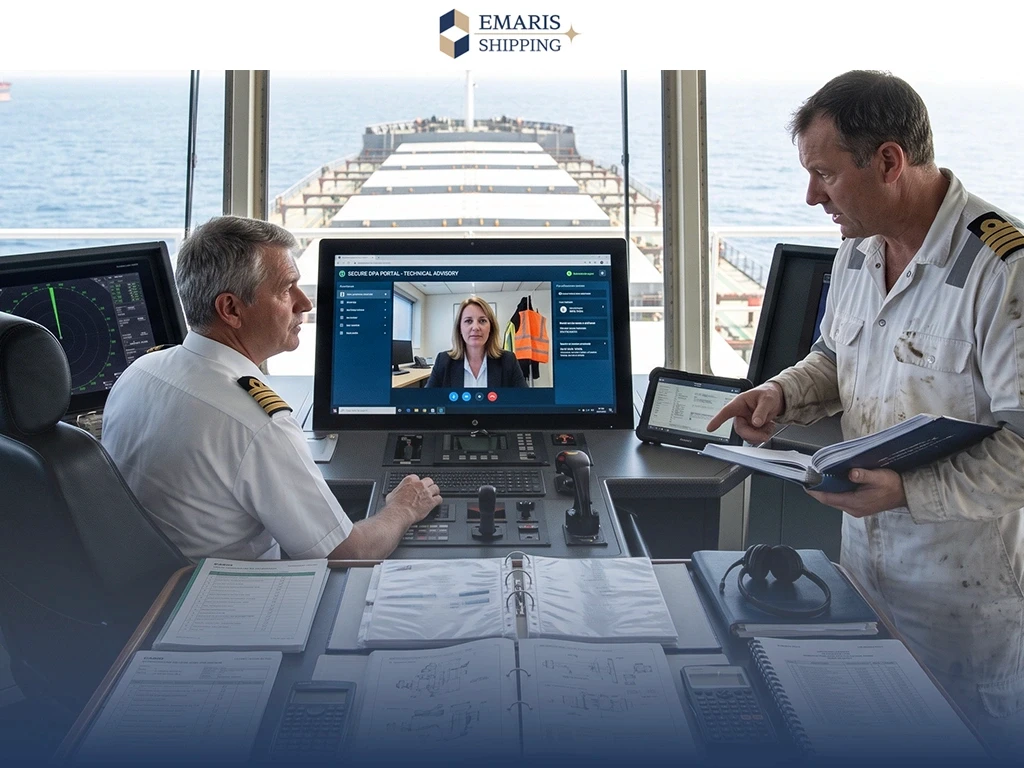
Every ship manager will tell you that compliance starts ashore. The Designated Person Ashore, the DPA, is the individual through whom that principle becomes operational. Required by the ISM Code for every company operating ships under SOLAS, the DPA is neither a figurehead role nor a purely administrative one. It is the critical link between the vessel's crew and the company's highest level of management, and in the context of technical ship management, it is one of the most consequential positions in the shore-based team.
This article explains what the ISM Code requires of the DPA, what the role looks like in practice within a professional ship management structure, and when ship owners should consider whether their current DPA arrangements are adequate.
What is a DPA Under the ISM Code?
The Designated Person Ashore is a mandatory appointment defined in Section 4 of the International Safety Management (ISM) Code. The ISM Code, incorporated into SOLAS Chapter IX and applicable to most commercial vessels above 500 GT, requires every company to designate "a person or persons ashore having direct access to the highest level of management" whose role is to monitor the safety and pollution-prevention aspects of ship operations.
The ISM Code's DPA requirement reflects a fundamental principle: that safe ship operation is a company-level responsibility, not just a shipboard one. The DPA is the mechanism through which the company exercises its safety obligations in practice.
Key statutory requirements for the DPA role:
The DPA must have direct access to the highest level of management, they cannot be subordinate to intermediate management layers when escalating safety concerns
The DPA must be identifiable to ship's personnel, crews must know who their DPA is and how to contact them
The DPA must have adequate resources and authority to fulfil the role, a DPA without the budget or authority to correct deficiencies is non-compliant in spirit, even if the appointment meets the letter of the ISM Code
DPA Responsibilities: What the Role Requires Day to Day
The DPA's responsibilities as defined by the ISM Code and as they operate in practice in a professional ship management environment cover six core areas:
1. Providing a Link Between Vessel and Company
The DPA is the primary point of contact for Masters and Chief Engineers raising safety concerns that cannot be resolved at vessel level. They ensure that information flows effectively between ship and shore in both directions, upward from vessel to management and back down so that management decisions and policies reach the crew in a usable form.2. Monitoring Safety and Pollution Prevention
The DPA maintains oversight of each vessel's compliance with the Safety Management System (SMS). This includes reviewing near-miss reports, accident investigations, and internal audit findings, and ensuring that corrective actions are tracked to completion.
3. Internal Audit Planning and Oversight
Under the ISM Code, companies must conduct internal audits of their SMS at intervals not exceeding 12 months. The DPA typically coordinates these audits, planning the audit schedule, ensuring auditors are independent from the functions being audited, and reviewing findings to drive system improvement.
4. Emergency Response
The DPA is part of the shore-based emergency response team for incidents involving vessels under management. When a vessel reports a casualty, grounding, fire, or pollution event, the DPA activates the company's emergency response procedures and serves as the primary operational link between the vessel's Master and the company's crisis response structure.
5. Regulatory Monitoring
Maritime regulations change continuously, IMO circulars, flag state requirements, classification society rule changes, MARPOL amendments, and MLC revisions all have implications for vessel operations. The DPA monitors regulatory developments and ensures that the SMS and onboard procedures are updated accordingly.
6. Continuous Improvement
The ISM Code requires companies to continuously improve their SMS based on experience and lessons learned. The DPA drives this process, reviewing trends in near-miss reporting, incident analysis, and audit findings to identify systemic weaknesses and initiate improvements before they manifest as incidents.
ISM Code Requirements: What the Auditors Will Check
When flag state auditors or classification society surveyors conduct an ISM audit, for the purpose of issuing or renewing a Document of Compliance (DOC) or Safety Management Certificate (SMC), the DPA function is one of the first areas examined.
Auditors will typically assess:
DPA identification: Is the DPA clearly identified in the SMS and on the vessel's contact list?
Access to management: Can the DPA demonstrate that they have direct access to the highest level of management without restriction?
Internal audit records: Are internal audits being conducted at the required frequency with appropriate independence?
Non-conformity management: Are non-conformities being investigated, corrective actions being implemented, and the effectiveness of those actions being verified?
Incident reporting: Is the DPA receiving and acting on near-miss reports and incident notifications from vessels?
DPA competence: Does the DPA have the maritime experience and management systems knowledge to fulfil the role effectively?
A well-functioning DPA operation should be evidenced through documentation, audit schedules, non-conformity registers, drill records, meeting minutes, and correspondence logs, that demonstrates active engagement, not passive administration.
Common Challenges for DPAs in Technical Ship Management
The DPA role is demanding, and in practice there are several common failure modes:
Inadequate access to management
In some companies, the DPA sits in a middle-management layer and faces practical barriers to escalating safety concerns to the board level. This undermines the core purpose of the role. A DPA who lacks genuine authority to stop a vessel operating under unsafe conditions is not fulfilling the ISM Code requirement.
Overload in small management operations
In small ship management companies, the DPA may simultaneously hold responsibilities as Technical Manager, Fleet Manager, or even Director. While this is not prohibited, it creates genuine risk of role conflict and workload overload, particularly in an emergency response situation.
Paper compliance versus active safety management
Perhaps the most common failure mode: an SMS that is maintained as a document set but not actively implemented on vessels. Near-miss reports that are never filed, internal audits that are run as a formality with no genuine assessment, and corrective actions that are closed without verification are all indicators that a DPA function is operating in compliance theatre rather than genuine safety management.
Crew unfamiliarity with the DPA
ISM Code auditors regularly find that crew members cannot name the DPA or do not understand how to escalate a safety concern ashore. This reflects inadequate communication between the DPA and the fleet and is a common minor non-conformity.
External vs In-House DPA: When to Consider Each Option
For ship owners managing their own vessels, the DPA is typically an in-house appointment, often the Technical Director, Operations Manager, or a dedicated Fleet Manager with appropriate qualifications. For ship owners who have outsourced vessel management to a third-party manager, the DPA function is typically held by the management company.
Some smaller ship owners or those with very small fleets opt to appoint an external DPA, an independent maritime professional who provides the DPA function on a contract or retainer basis. This approach is most appropriate when:
The owner manages a small fleet (1–3 vessels) that does not justify a full-time in-house DPA
The owner is transitioning from self-management to outsourced management and requires interim DPA coverage
The owner is a new entrant to ship operation and lacks the internal expertise to appoint a competent DPA from their existing team
External DPA arrangements are recognised under the ISM Code provided the individual has genuine direct access to the company's highest management level and adequate authority to act.
Emaris DPA Support: How We Serve Vessels Under Our Management
Emaris Shipping holds an ISM-certified safety management system with internal DPA coverage provided by our Director, Mr. Muhammad Sodiq, who is certified as a DPA, CSO, and Flag State Inspector with over 13 years of maritime operations experience specialising in HSSEQ management and ISM compliance.
For vessels under Emaris technical ship management, the DPA function is integrated into the daily management workflow, not handled as a separate compliance exercise. Our Masters and Chief Engineers have direct communication lines to the DPA at all times, and our internal audit programme runs on a documented annual schedule with findings tracked through to verified corrective action.
For ship owners with safety management questions or those evaluating their ISM compliance position, our ship safety management approach is detailed in our published content.
Frequently Asked Questions
Who can be appointed as a DPA?
The ISM Code does not specify formal qualifications for the DPA, but the person must be "suitably qualified", which in practice means having sufficient maritime operations or safety management experience to fulfil the role credibly. Many DPAs hold Master Mariner certificates, Chief Engineer licences, or formal safety management qualifications. The key statutory requirement is that they have direct access to the highest level of management.
Can a vessel have more than one DPA?
Yes. The ISM Code allows companies to designate "a person or persons" ashore, meaning more than one DPA can be appointed, for instance, to provide 24/7 emergency contact coverage. In practice, multi-vessel managers often have a primary DPA with designated deputies who can act when the primary DPA is unavailable.
What is the difference between a DPA and a CSO?
The DPA (Designated Person Ashore) is responsible for safety and pollution prevention under the ISM Code. The CSO (Company Security Officer) is a separate mandatory appointment under the ISPS Code, responsible for ship security matters. In many small ship management companies, the same individual holds both appointments, as is the case at Emaris Shipping.
How does a DPA differ from a Technical Manager?
The Technical Manager is responsible for maintaining the vessel's physical condition, machinery, hull, class compliance, dry docking, and procurement. The DPA's focus is on the Safety Management System, audit compliance, near-miss management, incident response, and crew safety culture. In many ship management structures, these roles overlap significantly, but they carry distinct ISM Code responsibilities.
External Sources: