TL;DR (Short answer): Crew management services are the outsourced function of recruiting, certifying, deploying, paying, and caring for the seafarers who run a vessel, delivered as a managed outcome rather than a piece of software. For tankers, the work is tighter than general cargo: officers need valid STCW tanker (oil) endorsements, the manning must satisfy MLC 2006 and the flag state, and the crew has to hold up under OCIMF SIRE 2.0 vetting. A full crew manager owns the whole lifecycle, from a vetted seafarer down to the wage slip and the flight home. If you only want a database to run your own crewing, that is crew management software, and it is a different purchase.
Crew management is the recruitment, certification, deployment, payroll, welfare, and repatriation of a ship’s seafarers, handled end to end by a specialist so the owner gets a manned, compliant vessel instead of a staffing headache. On a tanker that outcome carries more weight, because a single missing tanker endorsement or a rest-hours breach can cost you a charter, a vetting approval, or a Port State Control (PSC) clearance.
This guide is written for shipowners, operators, and DPAs who are weighing a crew manager for a tanker or bunker fleet and want to know what the service actually covers, where it goes wrong, and how to tell a real managed service apart from a tool. For a broader view of where crewing sits inside a manager’s remit, see What a Ship Management Company Really Does.
What are crew management services?
Crew management services are a managed contract under which a specialist takes responsibility for putting qualified, compliant seafarers on your ship and keeping them there. That covers sourcing and vetting candidates, checking and tracking certificates, issuing the seafarer employment agreement (SEA), arranging travel and joining, running payroll and allotments, handling welfare and medical cases, and organising the crew change and repatriation at contract end. The owner keeps commercial control of the vessel; the manager carries the manning obligation.
This is distinct from the narrower idea of a manning agent, which places individuals against a vacancy and steps back. A full crew manager owns the lifecycle and the compliance risk that comes with it. If you want the term defined from the ground up, our sibling explainer What Is Crew Management in Shipping? walks through it. The practical test is simple. Ask who is accountable at three in the morning when a chief officer fails a medical in a load port. With a manning agent, that is your problem. With a crew manager, it is theirs.
The crew lifecycle: recruitment, deployment, welfare
A crew manager runs one continuous lifecycle, and the value is in the handoffs between its stages, not in any single stage on its own.
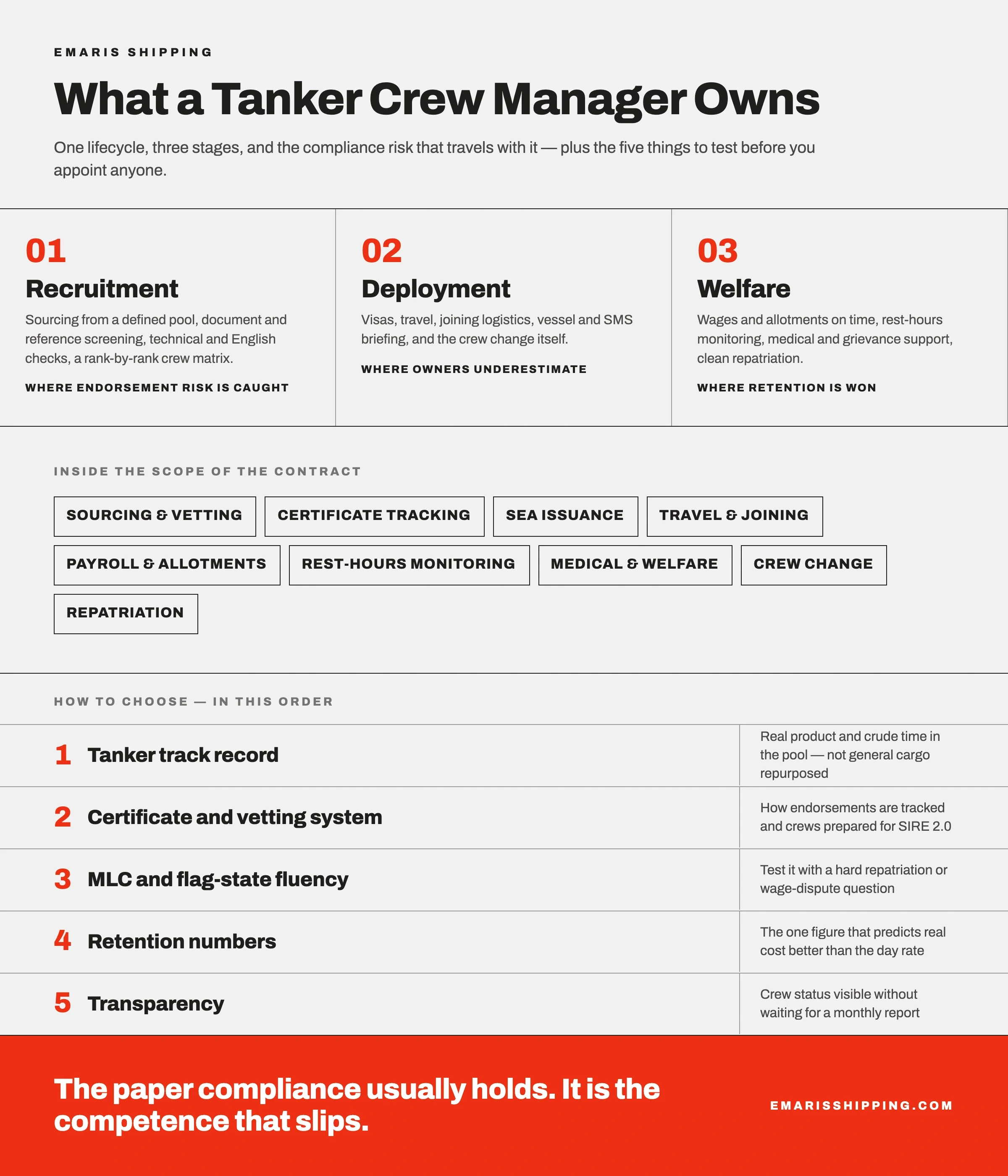
Recruitment comes first. The manager sources from a defined seafarer pool, screens documents and references, runs technical interviews and English-language checks, and builds a rank-by-rank crew matrix the charterer can review. For tankers this stage is where oil-endorsement and vetting risk is either caught or missed, so it deserves real scrutiny. We cover the tanker-specific version of it in Seafarer Recruitment and Manning for Tanker Fleets.
Deployment is the second stage: visa and travel arrangements, joining logistics, briefing on the vessel and the company safety management system, and the actual crew change. This is the stage owners underestimate. A crew that is perfect on paper is worth nothing if the relief cannot reach the ship, and crew-change planning around a tanker’s trading pattern is a craft in itself. The mechanics of it, including how a manager absorbs port and visa friction, sit in What Happens During a Ship Management Transition and How to Make It Smooth.
Welfare is the stage that decides whether the first two were worth doing. It runs across the whole contract: wage payment and allotments on time, rest-hours monitoring, onboard welfare and medical support, grievance handling, and a clean repatriation when the SEA ends. Welfare is not a soft extra. Under MLC 2006 it is a legal obligation, and it is the single biggest driver of retention, which is what actually lowers your long-run crewing cost.
Tanker and oil-endorsement manning
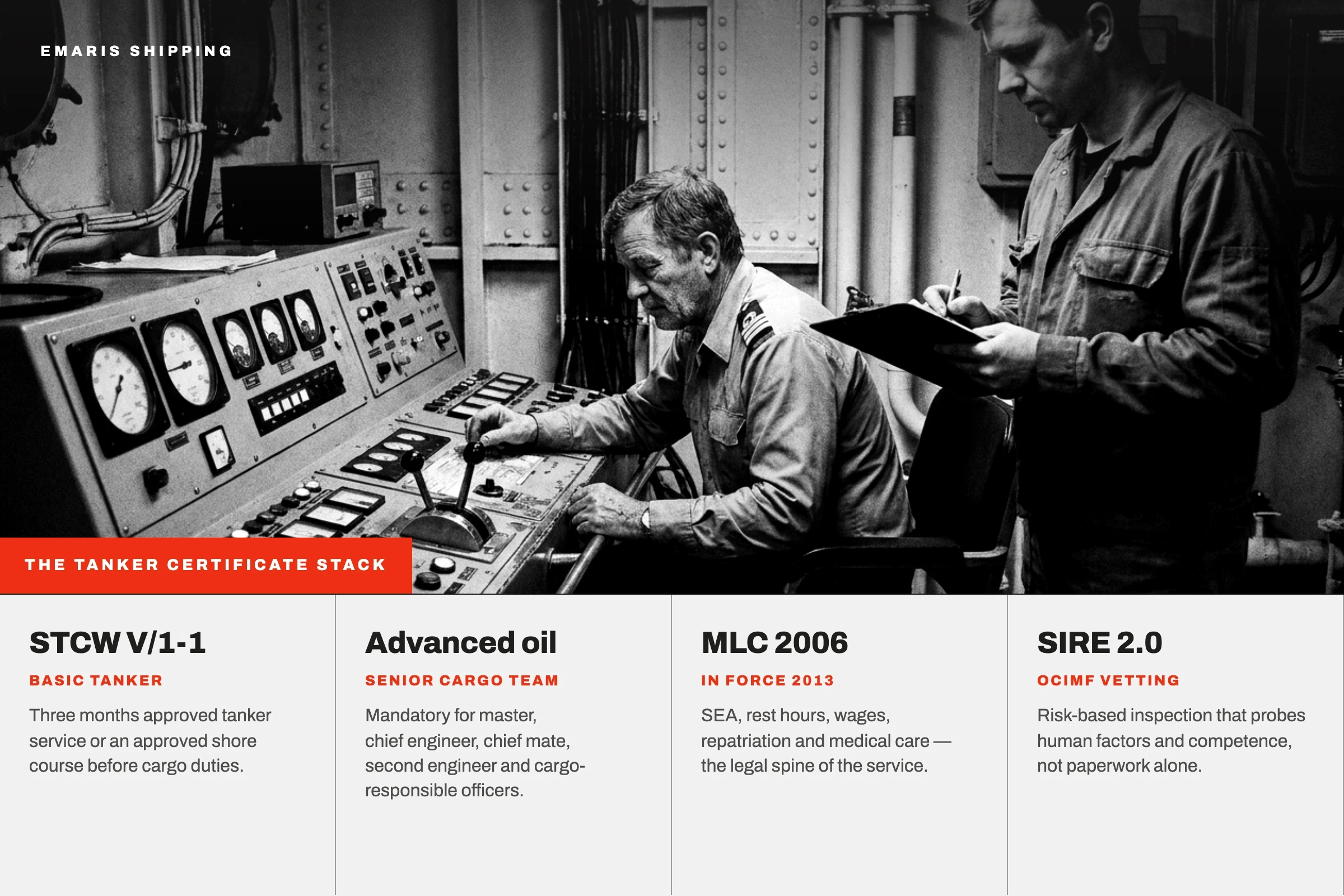
Tanker manning is a different discipline from general-cargo manning because the certificate stack is deeper and the vetting is external. Officers and ratings with cargo duties on an oil tanker have to hold STCW tanker training, and the senior cargo team needs the advanced tier. Under STCW Regulation V/1-1, basic training for tanker cargo operations requires at least three months of approved seagoing service on oil or chemical tankers or an approved shore-based course, and advanced oil tanker training is mandatory for the master, chief engineer, chief mate, second engineer, and anyone with immediate responsibility for cargo, according to the International Maritime Organization’s STCW Convention.
A crew manager who knows tankers builds this into recruitment rather than discovering it at the gangway. The check is not only “does the officer hold the endorsement,” but “does it stay valid for the whole contract, and does the crew matrix as a whole satisfy the charterer.” Our detailed reference on the certificate side is STCW Requirements: What Tanker Crew Must Hold.
Then there is vetting. Oil majors will not fix a tanker they do not trust, and the crew is a scored part of that trust. The OCIMF SIRE 2.0 inspection regime moved tanker vetting to a risk-based, question-per-inspection model that probes human factors and competence, not just paperwork on a bulkhead. A weak crew shows up in a SIRE 2.0 inspection quickly. This is why serious tanker crewing and vetting readiness are the same conversation, a point we make in How Emaris Ensures Seamless Compliance with SIRE 2.0 Through Smart Vetting, Crew Readiness.
Here is the operator judgment competitors rarely state plainly. On tankers, the expensive failures are almost never a missing STCW certificate, because that gets caught at screening. The expensive failures are competence gaps that only surface under inspection or in an actual cargo operation: an officer who holds the advanced oil endorsement but has thin recent tanker time, or a crew matrix that is technically compliant but light on real product-tanker experience for the trade. A good crew manager screens for the second problem, not just the first.
MLC 2006 compliance in crew management
MLC 2006, the Maritime Labour Convention, is the legal spine of crew management, and compliance with it is the main thing you are buying when you outsource crewing. The convention entered into force on 20 August 2013 and is treated as the fourth pillar of international shipping regulation alongside SOLAS, MARPOL, and STCW, per the International Labour Organization. It applies to commercially operated ships of 500 gross tonnage and above on international voyages, which covers essentially the whole tanker and bunker-tanker fleet an owner is likely to run.
In day-to-day crew management, MLC 2006 sets the rules a manager has to meet on the seafarer employment agreement, hours of work and rest, wage payment, repatriation, medical care, accommodation, and food. The convention also puts duties on the recruitment and placement service itself, so the manning agent is not outside the compliance perimeter. One consequence owners forget: under the MLC financial-security amendments, an abandoned seafarer is entitled to up to four months of outstanding wages and the reasonable costs of getting home, as the ITF Seafarers explains. That liability is real, and a competent crew manager is the party who keeps you clear of it. The full breakdown of the convention lives in our sibling article Ship Management SLA: What to Expect in a Ship Management Agreement.
The pain point here is exposure. An owner who runs crewing in-house without deep MLC and flag-state fluency carries the risk of a deficiency at a PSC inspection, a vetting rejection, or a detention that puts the ship off-hire. Buying crew management is, in large part, buying that risk off your own books and onto a party equipped to carry it.
Managed crew management vs crew management software
This is the disambiguation that trips up buyers, so it is worth being blunt. A managed crew management service and crew management software are not competing products; they answer different questions. Software is a tool you operate. A managed service is an outcome someone else is accountable for. The confusion matters because owners sometimes buy a licence expecting a manned ship, and they do not get one.
Question | Full crew management (managed service) | Crew management software (tool) |
|---|---|---|
What you receive | A crewed, compliant vessel | A system to run crewing yourself |
Who sources and vets seafarers | The manager, from its own pool | You do |
Who holds MLC 2006 and flag-state accountability | The manager | You do |
Who runs payroll, travel, crew change | The manager | You do, inside the tool |
Who answers a SIRE 2.0 crew finding | The manager | You do |
What you still need in-house | Commercial oversight | A full crewing department |
Best fit | Owners who want the outcome outsourced | Large operators with their own crewing team digitising it |
The honest read: software is excellent if you already have a crewing department and want to run it better. It does nothing for an owner who does not want a crewing department at all. Many operators end up using both, a manager who runs the crewing and software underneath to give the owner visibility. We compare the two purchases in full in Introducing PT Emaris Maritim Nusantara: A New Era of Integrated Crew Management in Batam, Indonesia. And to head off the search-engine confusion directly: this is maritime crew management for ships, not airline crew rostering or a generic HR platform.
Where crewing meets technical management
Crew and technical management are sold separately but they fail together. A well-run engine room depends on engineers who know that class of vessel, and a clean PSC record depends on a crew that runs the safety management system as intended rather than treating it as a binder. When an owner splits crewing and technical management across two providers with no shared accountability, the seam between them is where detentions happen. This is why many tanker owners keep both under one roof, a logic we set out in Vessel Technical Management: The Complete Guide. Crewing is the human half of the same safety outcome.
First-hand: what actually goes wrong
From the operator’s chair, the recurring failure in crew management is not recruitment quality. It is continuity. An owner switches managers to save a few dollars per day, the incoming manager cannot retain the existing crew, and six months later the vessel is carrying a green team into a demanding tanker trade with a vetting inspection due. The paper compliance held the whole time. The competence did not.
The second recurring failure is crew-change planning treated as logistics rather than strategy. On tankers with tight port rotations and restricted crew-change ports, the manager who plans reliefs a full rotation ahead keeps the ship running, and the one who reacts port by port racks up overtime, fatigue-related rest-hour breaches, and the occasional missed relief that leaves an officer over-contract. That is an MLC problem and a welfare problem at the same time.
Our stated opinion, as operators: owners consistently overweight the day rate and underweight retention. The cheapest crew manager on the quote is rarely the cheapest over three years, because turnover, familiarisation, and the incidents that come with an unsettled crew cost far more than the rate difference. Judge a crew manager on retention and vetting record first, price second.
How to choose a tanker crew manager
Look at five things, in this order. First, tanker-specific track record: real product and crude tanker experience in the crew pool, not general cargo repurposed. Second, the certificate and vetting system: how they track STCW tanker endorsements and prepare crews for SIRE 2.0, not just whether they promise to. Third, MLC 2006 and flag-state fluency, tested with a hard question about a repatriation or wage dispute. Fourth, retention numbers, because that single figure predicts your real cost and safety outcome better than the rate. Fifth, transparency, meaning you can see your crew’s status without waiting for a monthly report.
Emaris Shipping runs crew management for tankers and bunker vessels across Singapore, Southeast Asia, and the Middle East, with a crewing base including Batam, Indonesia, and the tanker vetting focus that comes from managing this vessel class every day. If you are weighing a manager for a tanker or bunker fleet, that is the standard to hold any provider to, ours included.
FAQ
What is included in crew management services?
A full crew management service includes seafarer sourcing and vetting, certificate and endorsement tracking, the seafarer employment agreement, travel and joining logistics, payroll and allotments, welfare and medical support, hours-of-rest and MLC 2006 compliance, and crew change and repatriation. In short, everything from finding a qualified seafarer to getting them home at contract end.
Is crew management the same as a manning agent?
No. A manning agent places individual seafarers against vacancies and stops there. A crew manager owns the full lifecycle and carries the compliance and welfare obligation, including MLC 2006 and flag-state duties. A manning agent staffs a gap; a crew manager delivers a manned, compliant ship.
What tanker certificates does the crew need?
Officers and ratings with cargo duties on an oil tanker need STCW basic tanker training, and the senior cargo team, including the master, chief mate, chief engineer, and second engineer, needs advanced oil tanker training under STCW Regulation V/1-1. A crew manager tracks these so no endorsement lapses mid-contract.
How does crew management support MLC 2006 compliance?
The manager holds the obligations MLC 2006 places on the employer and the recruitment and placement service: a compliant seafarer employment agreement, on-time wages, rest-hours monitoring, medical care, repatriation, and financial security against abandonment. Outsourcing crewing moves much of this exposure from the owner to a party built to carry it.
Is crew management software the same as a crew management service?
No. Software is a tool you operate with your own crewing department. A managed crew management service is an outcome, where the manager sources, vets, deploys, and takes accountability for the crew. Owners who want to be out of the crewing business need the service, not the licence.
How does a crew manager reduce vetting and detention risk?
By putting genuinely competent, tanker-experienced crews aboard and keeping the safety management system live rather than nominal, a crew manager reduces the human-factor findings that drive SIRE 2.0 vetting failures and PSC detentions. Certificates get you to the inspection; competence and retention get you through it.
Does this apply to bunker vessels as well as ocean-going tankers?
Yes. Bunker tankers face the same MLC 2006 and STCW tanker-endorsement obligations, often with more intense port and crew-change activity because of their trading pattern. The crewing discipline is the same; the logistics are tighter.
Quick Q&A for decision-makers
Should I buy crew management or crew management software? Buy the managed service if you do not want to run a crewing department, and buy software if you already have one and want to run it better. Do not buy the licence expecting a manned ship.
What single number should I ask a crew manager for? Retention rate by rank. It predicts your real three-year cost and your vetting and safety outcomes better than the day rate does.
Can I split crewing from technical management across two providers? You can, but the seam between them is where detentions happen. Keeping both under one accountable manager removes that risk, which is why many tanker owners do.
Next step
If you run tankers or bunker vessels and want crewing handled as a compliant outcome rather than a staffing task you supervise, that is the service to scope. Bring your fleet’s trade pattern, flag, and vetting requirements to the conversation, and judge any crew manager on tanker experience, MLC 2006 fluency, and retention before you look at the rate.