Between 2014 and 2023, machinery damage or failure accounted for more than 11,500 maritime incidents globally. These were not random events. They were the cumulative outcome of maintenance practices, monitoring gaps, and management decisions, most of which were visible in the vessel's operational data before the failure occurred.
This is the central argument for professional vessel technical management: machinery failures at sea are rarely the surprise they appear to be. They are the end of a chain: deferred maintenance, ignored condition trends, inadequate monitoring, or the absence of a management system capable of identifying deterioration before it reaches the failure threshold. Technical ship management, properly executed, intercepts that chain early. Reactive operations address the failure after it happens. Proactive management prevents it.
For DPAs, fleet managers, and ship owners managing tankers, bunker barges, and other commercial vessels in high-scrutiny operating environments, understanding how technical management prevents machinery failures is not an abstract question. It is a practical operational framework with direct commercial consequences.
Why Machinery Failures Happen: The Root Causes
Machinery failures at sea cluster around a consistent set of root causes, most of which are addressable through structured technical management rather than luck or crew vigilance alone.
Deferred maintenance is the most common structural cause. When planned maintenance tasks are not completed on schedule because parts are unavailable, because crew workload is prioritised elsewhere, or because the PMS is managed administratively rather than operationally, equipment runs beyond its safe maintenance interval. The probability of failure increases non-linearly as maintenance intervals are extended.
Inadequate condition monitoring allows deterioration to progress invisibly. Without systematic measurement of vibration, temperature, oil analysis, pressure, and other condition parameters, a technical manager cannot distinguish a well-functioning piece of equipment from one that is approaching failure. The absence of monitoring data does not mean the equipment is healthy; it means the deterioration is happening without warning.
Poor spare parts management prevents maintenance from being executed even when it is correctly planned. A maintenance task that cannot be completed because the required part is not onboard shows a failure of supply chain integration with the PMS.Crew competency gaps allow early warning signs to be missed or misinterpreted. An experienced chief engineer who understands the vessel's machinery profile will recognise an unusual vibration or temperature trend as a potential indicator. An underqualified or newly rotated crew member may not.
Inadequate shore-side oversight allows vessel-level management gaps to persist undetected. Without regular superintendent visits, real-time monitoring capability, and structured reporting that surfaces deteriorating trends, shore-based technical managers cannot intervene before problems become failures.
The Role of the Technical Manager in Machinery Failure Prevention
The technical ship manager's role in machinery failure prevention operates across three time horizons: before the failure, during the event, and in the post-failure recovery period.
Before failure: proactive maintenance and monitoring
The primary technical management activity is structured, maintaining the planned maintenance system at a discipline level that keeps critical equipment within safe maintenance intervals, monitoring condition parameters for early warning signals, managing spare parts availability so maintenance can be executed when scheduled, and deploying superintendents to verify that vessel-level execution matches the plan.
This is the proactive horizon. It is also where the return on investment in technical management is largest, because prevention is structurally cheaper than repair, and prevention with vessel availability intact is structurally cheaper than prevention after an off-hire event.
During the event: incident response and damage limitation
When a machinery failure does occur despite proactive management, the technical manager's role shifts to emergency response, mobilising the right technical support (shore-based superintendent, specialist engineers, or equipment manufacturer technical assistance), coordinating spare parts procurement on an emergency basis, managing class society and flag state notification obligations, and communicating with the owner on commercial implications and timeline.
A technical manager with an established emergency response protocol and a functional supplier network can compress the off-hire period of a machinery failure significantly compared to a manager without these capabilities.
Post-failure: root cause analysis and recurrence prevention
Under the ISM Code, a formal root cause analysis and corrective action process is required following serious machinery incidents. The technical manager conducts this investigation, identifies the contributing factors, and implements the corrective actions, whether to the PMS, the monitoring protocols, the spare parts management, or the crew training, that prevent recurrence.
The quality of this process matters commercially: a thorough root cause analysis that produces genuine corrective actions improves the vessel's reliability trajectory. A superficial one that closes the finding without addressing root causes leaves the underlying risk in place.
Predictive Maintenance: Moving Beyond Fixed Intervals
Traditional planned maintenance operates on fixed intervals; equipment is serviced every X running hours or every Y months, regardless of actual condition. This is adequate but not optimal: it produces over-maintenance for equipment in good condition and potentially under-maintenance for equipment operating in challenging conditions.
Predictive maintenance is the practice of scheduling maintenance based on actual equipment condition, using real-time sensor data, vibration analysis, thermography, oil analysis, acoustic monitoring, and pressure measurement to detect early-stage deterioration and schedule intervention before failure.
For critical ship machinery, main engines, steering gear, critical pumps, and cargo handling systems, predictive approaches offer two advantages over fixed-interval maintenance. First, they reduce over-maintenance costs for equipment in good condition. Second, they provide earlier warning of genuine deterioration, narrowing the window between initial signal and failure threshold.
The adoption of predictive maintenance in commercial shipping has accelerated with the availability of IoT sensors, real-time data connectivity, and AI-based anomaly detection platforms. For technical managers operating with digital monitoring infrastructure, the shift from pure planned maintenance to a hybrid planned-and-predictive framework is increasingly achievable without prohibitive technology investment.
Condition Monitoring: The Practical Warning System
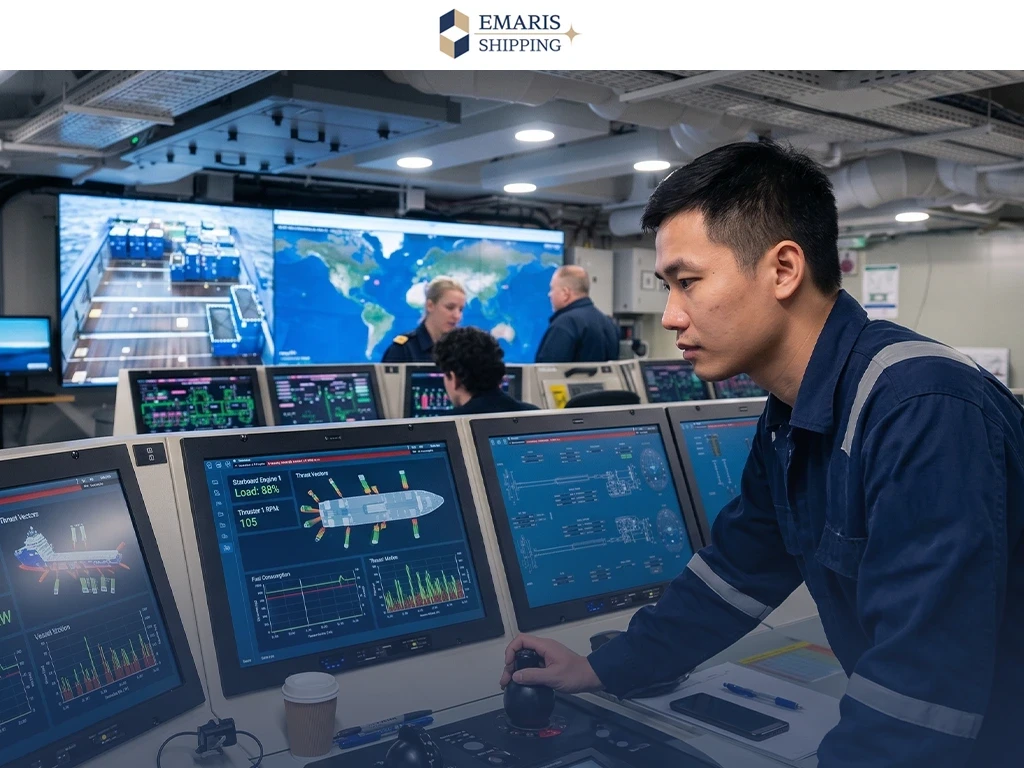
Condition monitoring in technical ship management is the continuous or periodic measurement of parameters that indicate machinery health and the use of that data to inform maintenance decisions.
The most common condition monitoring practices for commercial vessel machinery include:
Vibration analysis measures vibration signatures on rotating machinery (engines, pumps, compressors, fans) to detect bearing wear, imbalance, misalignment, or other mechanical deterioration before it progresses to failure.
Oil analysis: periodic laboratory analysis of lubricating oil samples to detect metal wear particles, contamination, and chemical degradation that indicate bearing or component wear before macroscopic failure.
Thermography is thermal imaging of electrical panels, switchboards, and machinery to identify hot spots that indicate overload, poor contact, or incipient failure in electrical systems.
Performance trending, tracking fuel consumption, exhaust temperature differentials, and power output trends for main and auxiliary engines to detect gradual performance degradation from fouling, timing drift, or component wear.
These monitoring practices do not replace planned maintenance; they complement it, providing the early warning signal that triggers targeted intervention before the planned interval requires it.
Emergency Response: What Happens When Prevention Fails
Despite well-structured technical management, machinery failures will occasionally occur. The technical manager's emergency response capability and the speed with which they can mobilise resources directly determine the commercial impact of the failure.
Effective emergency response in ship technical management requires: a 24/7 contact protocol with clear escalation paths, a pre-established network of shore-based technical specialists across relevant equipment types, relationships with equipment manufacturers' technical assistance services, emergency spare parts sourcing capability across the regional port network, and clear communication protocols with the owner, the charterer, the insurer, and class and flag state authorities.
For tanker and bunker operations in Singapore and Southeast Asia, where the regional port network provides access to technical resources, a manager with established supplier relationships and regional logistics capability compresses emergency response timelines significantly.
How Emaris Prevents Machinery Failures
Emaris Shipping's approach to machinery failure prevention within its ship management services integrates planned maintenance discipline, condition monitoring, and proactive superintendent oversight into a unified technical management model.
The Emaris technical team manages PMS execution as an active operational KPI, tracking overdue task ratios, monitoring condition trends for critical equipment, and deploying superintendents to investigate any deterioration signals that emerge from regular vessel reporting.
Emaris's perspective on this is grounded in a consistent observation: vessel uptime failures rarely start with equipment. They start with management gaps, deferred maintenance, untracked condition deterioration, inadequate crew engagement with the PMS, or shore-side oversight that does not catch accumulating risk before it reaches the failure threshold.
Addressing those management gaps through disciplined PMS execution, active condition monitoring, structured superintendent oversight, and the real-time visibility that EmarisOne provides is the practical framework through which technical ship management prevents machinery failures at sea rather than responding to them after the fact.
Frequently Asked Questions
What are the most common causes of ship machinery failure? The most common causes are deferred planned maintenance, inadequate condition monitoring, spare parts unavailability preventing scheduled maintenance, crew competency gaps that allow early warning signs to be missed, and shore-side technical oversight that identifies problems too late to prevent failure. Most failures are preventable through disciplined technical management rather than being genuinely random events.
How does a planned maintenance system prevent machinery failures? A PMS prevents failures by ensuring that every piece of critical equipment is maintained within its manufacturer-defined safe operating interval. When PMS discipline is high, tasks are completed on time, spare parts are available, records are accurately maintained, and equipment operates within its intended reliability envelope. When PMS discipline deteriorates (high overdue task ratios, deferred maintenance), failure probability increases.
What is predictive maintenance on ships? Predictive maintenance uses real-time condition monitoring data, vibration, oil analysis, thermography, and performance trending to schedule maintenance based on actual equipment condition rather than fixed time intervals. It provides earlier warning of deterioration than fixed-interval maintenance alone, allowing intervention before failure rather than after.
What should happen after a machinery failure at sea? The technical manager should conduct a formal root cause analysis under the ISM Code non-conformity process, identify all contributing factors, implement corrective actions to address root causes (not just symptoms), and verify that corrective actions are effective through follow-up monitoring. This process should produce a documented investigation record that satisfies class society and flag state audit requirements.
How do technical ship managers use condition monitoring data? Condition monitoring data is used to detect early-stage deterioration in critical machinery, trigger targeted maintenance intervention before failure occurs, adjust PMS intervals based on actual equipment condition, and provide documentary evidence of machinery health for class survey and vetting preparation.
External Sources