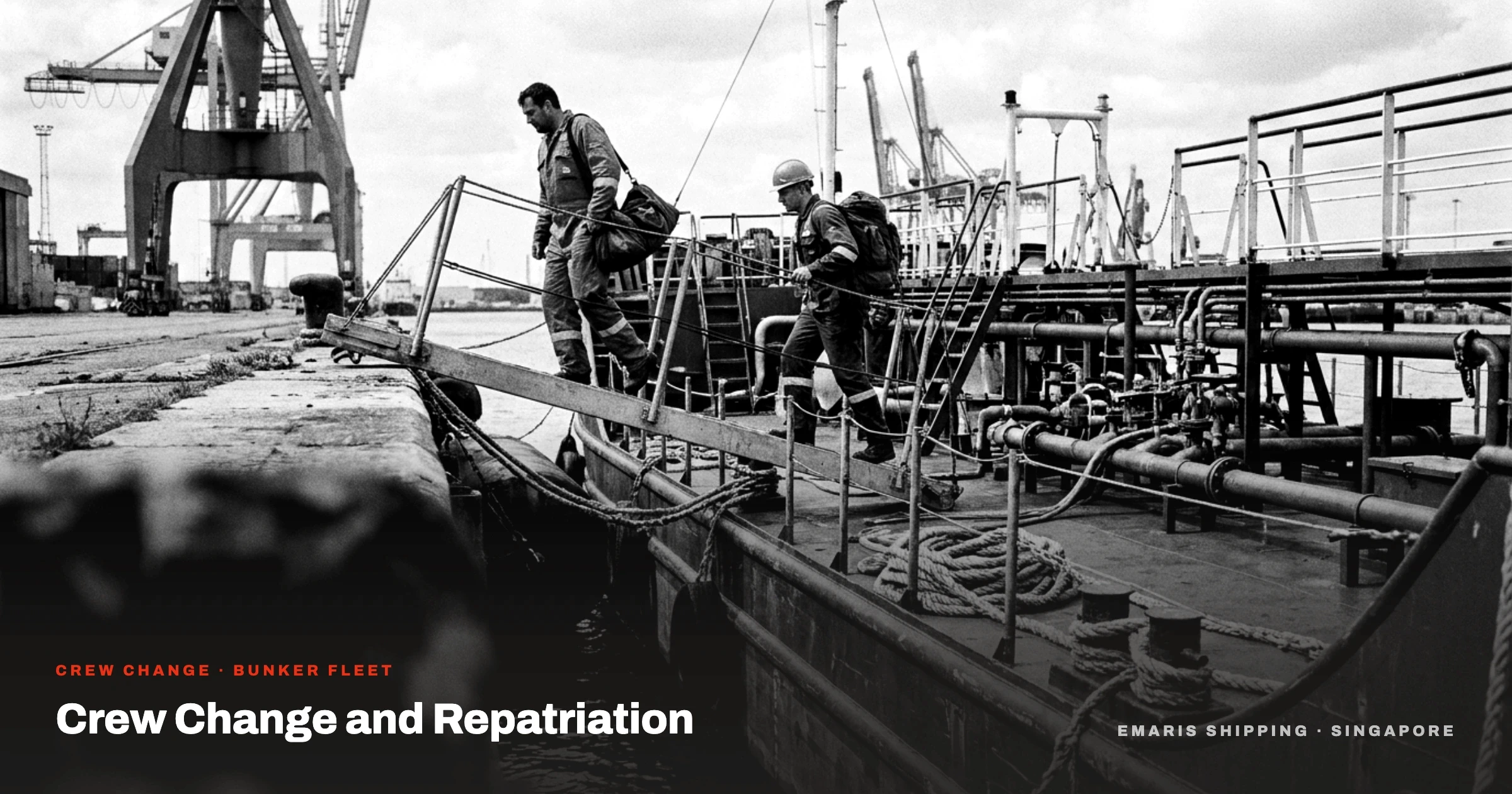
Short answer: A crew change is the planned relief of seafarers at a port, one crew signing off and their reliefs signing on, so the vessel keeps a certificated, rested complement. Repatriation is the seafarer’s legal right to be sent home, and under MLC 2006 the shipowner carries the duty and the cost. The practical driver is time: a seafarer can serve a maximum of about 11 months continuously before repatriation is due, so a manager plans every rotation backwards from that limit. Done well, a crew change is a scheduled port call that adds no off-hire. Done late, it becomes visas at short notice, a diverted call, and MLC exposure. The 2020-21 crew-change crisis, when up to 400,000 seafarers were stranded at sea, showed what happens when the process breaks down.
If you run tankers, crew change is one of the few recurring events that touches labour law, immigration, port logistics, cost, and vetting at once. Get the timing and the paperwork right and it is invisible in your accounts. Get them wrong and you are paying for a special call, arguing about an expired contract, and explaining to a vetting inspector why a mariner is weeks over his agreement. This guide sets out how a manager runs the process: the repatriation duty under MLC 2006, how rotations are planned, how visas and documents are handled, how the port agent fits in, where the cost sits, and what the pandemic taught the industry. We manage tanker and bunker-vessel fleets with a crewing base in Batam, so the notes below come from booking real reliefs into real port calls.
What is a crew change, and where does repatriation fit?
A crew change is the operation of relieving serving seafarers with their reliefs, normally alongside or at anchor during a commercial port call. The off-signers leave the vessel and travel home; the on-signers join, hand over, and take up their duties. Repatriation is the leg that gets the off-signers home, and it is not a courtesy. It is a right the seafarer holds and a duty the shipowner and manager carry.
The two are linked but distinct. A crew change is the logistics event at the quay; repatriation is the legal obligation it exists to satisfy. You can, in an emergency, repatriate a seafarer without a matching relief for medical or compassionate reasons, but in normal operation the two happen together, because a tanker cannot sail short of its certificated minimum manning. That single constraint, keeping the ship legally crewed at every moment, is what makes crew-change planning unforgiving. This article is part of the crew hub anchored by Maritime Crew Management Services for Tankers, and it sits alongside the broader question of What Is Crew Management in Shipping?.
The manager’s repatriation duty under MLC 2006
Under the Maritime Labour Convention, 2006, repatriation is a right the seafarer cannot sign away and the shipowner cannot charge for. Standard A2.5.1 gives every seafarer the right to be repatriated at the end of their period of service, and the cost sits with the shipowner, not the mariner. That is the legal spine of the process, and the reason a manager treats a rotation as a compliance event rather than a travel booking.
The time limit drives the calendar. MLC 2006 sets the maximum duration of continuous shipboard service after which a seafarer is entitled to repatriation at less than twelve months. Read with the paid-leave entitlement of 2.5 days per month, the practical ceiling is about 11 months on board without leave, which the ILO itself confirms. A manager therefore plans every relief to land the seafarer home before that 11-month line, not on it. The ILO’s MLC guidance on repatriation sets out the entitlement, and the Australian Maritime Safety Authority’s note on the maximum period of shipboard service explains how the 11-month figure is derived. Because these obligations run through the seafarer’s employment agreement, they overlap with the wider duties covered in MLC 2006 Explained: Maritime Labour Convention Compliance.
Here is the operator’s read on this. The 11-month figure is a legal maximum, not a target. Treat it as a target and you have no margin: one delayed visa, one charterer refusing a deviation, and a mariner tips over his contract while you scramble. A ship over its MLC limits is also a finding waiting to happen at a port-state or vetting inspection, which is why crew-change discipline shows up directly in the outcomes we describe in How Ship Managers Handle PSC Inspections.
How managers plan a crew rotation
Rotation planning works backwards from the contract end date and the vessel’s schedule, not forwards from convenience. The manager’s job is to find the port call that lands a relief comfortably inside each seafarer’s contract window, with enough lead time to get visas, flights, and a rested reliever into position. A crewing team runs this as a rolling relief plan for the whole fleet, usually three to four months ahead.
Each vessel carries a shortlist of candidate crew-change ports drawn from its trade pattern, ranked by how easy they are to work: visa regime, airport connections, agent quality, and cost. A tanker on a fixed Arabian Gulf to India run has a very different shortlist from a bunker vessel working Singapore anchorages. The plan is revised every time the schedule moves, because a single voyage change can knock a planned port off the table. Matching the right reliever to the right ship is its own discipline, covered in Seafarer Recruitment and Manning for Tanker Fleets, and for tankers the reliever must also hold current tanker endorsements, as set out in STCW Requirements: What Tanker Crew Must Hold.
Visas, travel, and documentation
The paperwork is where good plans go to die. Every joiner and leaver needs a valid passport, a seafarer’s identity document or Continuous Discharge Book, the right transit or crew visa for the change port, and a connecting air ticket, sitting alongside the vessel-side crew list and flag-state and port formalities. Miss one visa and the whole change slips to the next port.
Visas are the long pole. Some hubs, Singapore among them, are used to seafarer transit and process crew smoothly through an appointed agent. Others require a crew visa applied for weeks ahead, sometimes with an embassy appointment in the seafarer’s home country. A competent crewing office keeps a live map of visa lead times by nationality and by port, because a Filipino and an Indian officer joining the same ship at the same port can face very different processing times. The document check is done twice: once when the relief plan is set, and again 72 hours before the change, because passports expire and visas get rejected. That second check is the one that saves the port call.
Port and agent coordination
The port agent is the manager’s hands at the quay, and a crew change succeeds or fails on how well the agent is briefed. The agent clears the joining and leaving crew with immigration, arranges transport between airport and vessel, confirms launch or gangway access, and handles any shore-pass or health formalities. The manager sends a crew-change advice: who is joining, who is leaving, flight details, document copies, and the timing window against the ship’s ETA.
Timing is the hard part, because the change has to fit inside the commercial call. A tanker alongside for a twelve-hour discharge gives a narrow window for immigration, transport, and handover, and if the reliever’s flight is late the leaver may sail on. On a bunker vessel doing several anchorage deliveries a day, the window is tighter still. A change that needs the ship to wait is a commercial conversation as much as a logistics one, which is why the manager coordinates the agent, terminal, and often the charterer. This is the same interface that comes into play in How Ship Managers Handle Emergencies and Incident Response, and the scope of who arranges and pays for what is normally pinned down in the management agreement, as we set out in Ship Management SLA: What to Expect in an Agreement.
Cost and logistics: planned versus reactive
The single biggest cost lever in crew change is lead time. A relief planned three months out is flights booked at advance fares into a convenient hub. The same relief forced at two weeks’ notice is full-fare tickets, a possible vessel deviation, expedited visas, and sometimes a hotel while a seafarer waits for a berth. The table sets out how the two diverge across the dimensions a manager tracks.
Dimension | Planned crew change | Reactive or forced change |
|---|---|---|
Lead time | 8 to 12 weeks | Days to two weeks |
Airfare | Advance-purchase, routed via a hub | Full-fare, whatever connects |
Change port | Chosen for cost and visa ease | Whatever the ship reaches in time |
Off-hire risk | None, folded into a commercial call | Possible deviation or waiting time |
MLC exposure | Within contract, margin intact | Contract expiry pressure, overrun risk |
Vetting exposure | Rested, certificated crew | Fatigue and documentation findings |
Read as a checklist, the cost-controlled crew change comes down to a handful of habits. Plan the relief inside the contract window with weeks of margin. Choose the change port for visa ease and flight connections, not just because the ship is passing. Book travel early and hold it against the schedule. Verify documents twice, brief the agent fully, and confirm the window against the real ETA. Keep a fallback port ready for the day the schedule moves. That discipline is the difference between crew change as a line item you barely notice and crew change as a series of expensive surprises.
An operator’s note from the quay
The mistake we see most often from owners who self-manage crewing is treating the contract end date as the deadline rather than the outer wall. A relief booked for the day the contract expires has zero tolerance for the things that always go wrong: a delayed flight, a visa query, a berth that slips a tide. We plan reliefs to land the joiner two to four weeks inside the contract, and we hold at least one fallback port for every change. It looks like over-caution until a fixture changes and the primary port drops off the schedule, and the margin is the only reason a seafarer gets home on time and the ship stays legally crewed. Our crewing base in Batam exists partly for this reason: reliefs close to the Singapore and Malacca Strait lanes shorten the travel leg and give us more usable change ports within reach.
What the 2020-21 crew-change crisis taught the industry
The pandemic turned a routine process into a humanitarian emergency and proved how fragile the system is. At the peak, up to 400,000 seafarers were unable to be repatriated and were stranded at sea beyond their contracts, with an equivalent number stuck ashore unable to join and earn; by May 2021 the stranded figure was still around 200,000. The IMO’s reporting on the crew-change crisis documented the scale, and the UN General Assembly urged governments to designate seafarers as key workers to let reliefs move across borders.
The operational lesson was blunt: when borders close, the whole crew-change machine seizes, because it depends on flights, visas, and shore access outside the manager’s control. Managers who came through it best had diversified change ports, direct agent relationships in multiple jurisdictions, and crewing bases in more than one country, so that when one route closed another stayed open. Seafarers held on board past 11 months, some past 17, exposed owners to real MLC breaches, and the repatriation right stopped being a paperwork clause and became the thing that mattered most.
Our owned opinion, formed running fleets through that period: resilience in crew change is worth paying a small premium for. A manager who only ever uses the single cheapest change port has no fallback the day it closes. Redundancy in ports, agents, and crewing geography is not inefficiency. It is insurance, and the crisis priced it fairly.
Frequently asked questions
What is the difference between a crew change and repatriation? A crew change is the physical relief of crew at a port, sign-off and sign-on together, so the ship keeps its certificated complement. Repatriation is the seafarer’s legal right to be returned home, which the crew change delivers for the off-signing crew. One is the logistics event; the other is the legal duty behind it.
How long can a seafarer stay on board before repatriation? Under MLC 2006 the maximum period of continuous service before a seafarer is entitled to repatriation is less than twelve months, and read with the paid-leave entitlement this works out to a practical maximum of about 11 months without leave. Managers plan reliefs to land well inside that limit, not on it.
Who pays for a seafarer’s repatriation? The shipowner. Under MLC 2006 Standard A2.5.1 the cost of repatriation falls on the shipowner, and a seafarer cannot be required to pay for it except in narrow cases of serious default. Financial-security cover must also be in place in case the owner fails.
What documents does a seafarer need for a crew change? A valid passport with sufficient validity, a seafarer’s identity document or Continuous Discharge Book, the correct transit or crew visa for the change port, a connecting air ticket, and the vessel-side paperwork such as the crew list and the agent advice. That set is checked when the relief is planned and again about 72 hours before the change.
Why do crew changes get delayed? The usual causes are visa processing that runs longer than expected, flight disruption, a vessel schedule change that removes the planned change port, or a commercial call too short to fit the change. Border closures, as in 2020-21, can stop the process entirely.
Quick Q&A for decision-makers
We keep getting surprised by crew-change costs. What is the single biggest fix? Lead time. Almost every expensive crew change is a late one. A relief planned eight to twelve weeks out, into a chosen hub, on advance fares, costs a fraction of the same relief forced at two weeks with a possible deviation. Push your manager for a rolling relief plan you can see, not ad-hoc bookings.
Our vessels trade a volatile schedule. How do we avoid MLC overruns? Plan reliefs to land two to four weeks inside each contract and hold a fallback change port for every ship. The margin absorbs the schedule moves that would otherwise tip a seafarer over his contract. If your crewing is run to the contract end date with no buffer, you are one fixture change away from an MLC breach.
Where Emaris fits
Crew change rewards a manager who plans it as a rolling discipline rather than a series of bookings: a live relief plan across the fleet, reliefs landed inside the MLC limits with real margin, change ports and agents chosen for resilience, and a crewing base close to the trade. We run tanker and bunker fleets this way from Singapore and Batam, keeping crews certificated, rested, and home on time. If crew-change cost and MLC exposure are giving you surprises, talk to Emaris about managed crewing for your fleet, and compare it against the software-only route in Managed Crewing vs Crew Management Software.