
A classification survey reflects a preparation process that begins months, sometimes years, in advance, so very little is decided on the day itself. When a surveyor from Class steps onboard, the professional ship manager's job is largely already done: the vessel should be in a documented, maintained, and survey-ready condition at all times.
This guide explains what classification societies require, the different types of surveys vessels must undergo, and how technical ship managers structure the preparation process to deliver clean survey outcomes for their owners.
What is a Classification Society and Why Does It Matter?
A classification society is an independent technical standards body that establishes and verifies the structural and mechanical integrity of commercial vessels. Class certification is a prerequisite for operating commercially. Without a valid class certificate, a vessel cannot be insured under standard P&I and H&M policies, will be refused access to most commercial ports, and cannot trade under most charter party agreements.
The five classification societies most relevant to vessels operating in the Singapore and regional Asian trading range are:
Lloyd's Register (LR), one of the oldest and most globally recognised societies
DNV (Det Norske Veritas), the world's largest classification society by fleet size
Bureau Veritas (BV), particularly prevalent in tanker and offshore fleets
ClassNK (Nippon Kaiji Kyokai), the dominant society for Japanese-built tonnage
American Bureau of Shipping (ABS), common in US-linked and offshore trades
The choice of classification society is typically set at vessel construction and recorded on the ship's certificates. Changing class is possible but involves a formal survey process and is rarely undertaken lightly.
Types of Class Surveys: Annual, Intermediate, and Special Periodical
Class surveys follow a structured schedule tied to the vessel's certification cycle. Understanding this schedule is one of the first responsibilities of a technical ship manager taking on a new vessel.
Annual Surveys
Conducted every 12 months, annual surveys focus on verifying that the vessel remains in compliance with class requirements in service. The surveyor inspects key safety systems, structural elements, machinery, and statutory equipment. Deficiencies identified at annual survey must be corrected within a defined timeframe, minor items may be granted a Condition of Class (CoC), but ongoing or serious deficiencies can result in suspension of class.
Intermediate Survey
Required at the midpoint of the five-year special periodical survey cycle (typically at the 2.5-year mark), the intermediate survey is a more detailed inspection than an annual survey. For tankers, the intermediate survey typically includes in-water or dry dock hull inspections depending on vessel age and the classification society's requirements.
Special Periodical Survey (SPS) / Renewal Survey
The most comprehensive class survey, conducted every five years and typically aligned with the vessel's dry dock period. The SPS covers the full hull, all main and auxiliary machinery, cargo systems, mooring equipment, and safety systems. Older vessels face more extensive steel thickness measurements and structural assessments.
Continuous Survey Programme
Many ship managers elect to enrol vessels in a Continuous Survey programme, which distributes survey items across the five-year cycle. This avoids the concentration of workload at the special periodical survey and helps maintain survey readiness throughout the cycle.
Preparation: The 12-Month Survey Readiness Cycle
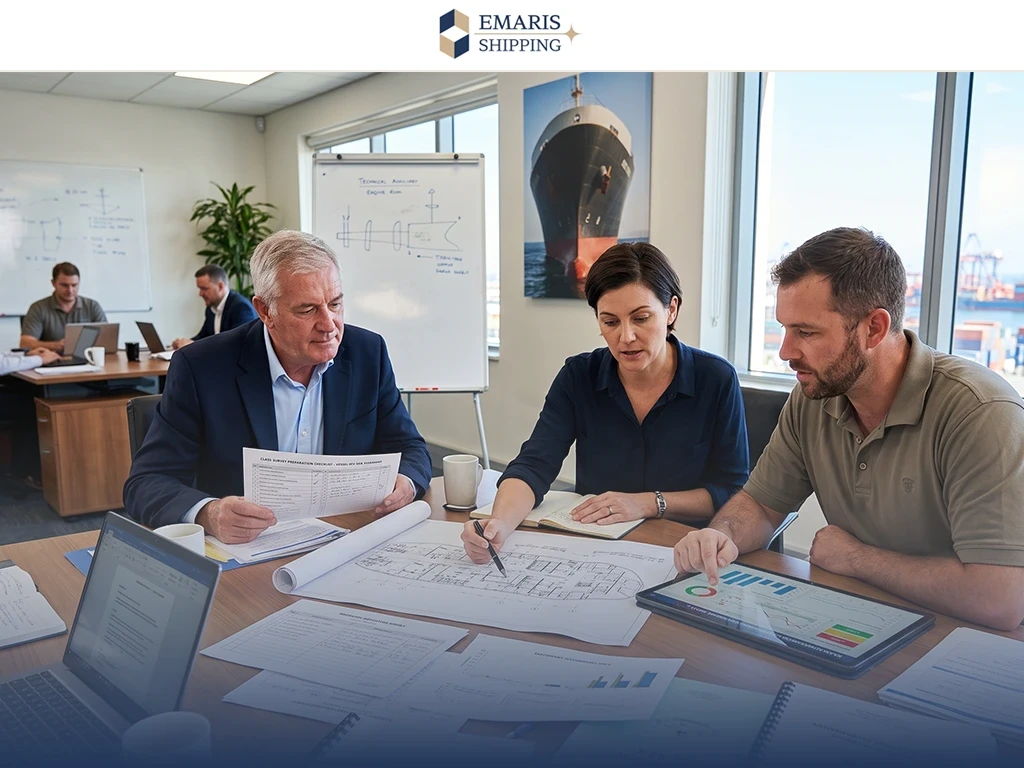
Professional ship managers treat survey readiness as a continuous process, with no last-minute sprint before the survey. The standard preparation workflow for a major class survey follows a structured timeline:
12 months before survey:
Review the class survey due list (available via classification society online portals such as DNV Veracity or LR's MyLR)
Identify all items due at the upcoming survey and those currently subject to Conditions of Class
Commission any preparatory inspections (thickness gauging, underwater surveys) that require advance scheduling
6 months before survey:
Finalise the dry dock specification if the survey coincides with a scheduled dry docking
Begin vendor tendering for repair yard selection if applicable
Raise purchase orders for parts and materials required for known deficiencies
3 months before survey:
Complete internal pre-survey inspections against the class checklist
Ensure all statutory certificates (Safety Construction, Safety Equipment, Safety Radio, Load Line, IOPP) are current and their renewal surveys are aligned with the class survey schedule
Confirm surveyor booking with the classification society
Survey period:
Technical superintendent present during the survey
Full documentation package available onboard: maintenance records, repair history, test certificates, IOPP annexes, oil record book
Chief Engineer briefed on survey scope and ready to demonstrate machinery in operation
Common Deficiencies and How Good Preparation Prevents Them
The most common deficiencies identified at class surveys are those that could have been identified and corrected months earlier if a systematic pre-survey inspection had been conducted. Based on classification society PSC detention data and industry experience, recurring deficiency categories include:
Corrosion and structural degradation, accelerated by inadequate coating maintenance between surveys
Lifeboat and LSA deficiencies, hydrostatic release units past expiry, lifeboat engine failures, pyrotechnics out of date
Fire detection and suppression system faults, fixed CO₂ systems with incorrect cylinder charges, smoke detectors with degraded sensitivity
Machinery deficiencies, overdue maintenance on steering gear, emergency generator, bilge pumping systems
Certificate gaps, IOPP Supplement or Oil Record Book discrepancies that create statutory compliance exposure
A technical manager who conducts a rigorous pre-survey walkthrough against the classification society's survey checklist should identify the majority of these items before the surveyor arrives.
Documentation Requirements: What Must Be Ready on the Day
Survey outcomes depend on the physical condition of the vessel and on the documentary evidence that supports it. Surveyors expect to see:
Maintenance records, evidence that PMS jobs have been completed on schedule, with records signed by the responsible officer
Repair records, repair reports, workshop certificates, and weld test certificates for any structural or machinery repairs conducted since the last survey
Thickness gauging reports, for hull, deck plating, and internal structural elements as applicable
Test certificates for safety equipment (pressure vessels, lifting gear, mooring equipment, fire extinguishers)
Oil Record Book, properly maintained, with no unexplained gaps or corrections
Crew certification records, STCW certificates for all officers and ratings, confirming compliance with the manning requirements for the vessel type
Classification societies increasingly accept digital documentation, and some (notably DNV via its Veracity platform) offer survey management services that allow managers to track due items and submit documentation remotely.
How Emaris Manages Class Survey Preparation
At Emaris Shipping, our Technical Manager Mr. P Elanzaran brings over 17 years of ship management experience that spans multiple vessel types and classification societies including Lloyd's Register, DNV, and Bureau Veritas. This depth of experience means our team knows what surveyors require and how to present the vessel and its documentation in a way that supports a clean, efficient survey outcome.
Our survey preparation process begins from the moment we take on technical management of a vessel. We establish the full survey due list on day one, maintain a rolling 12-month survey calendar, and integrate survey preparation into the vessel's planned maintenance system.
For vessels requiring marine audits or pre-survey inspections, our marine audits and surveys team provides independent verification that the vessel is prepared to the standard that major classification societies expect.
Ship owners whose vessels fall under Emaris technical ship management services receive a transparent survey status report as part of their regular management reporting, so there are no surprises when the surveyor steps onboard.
Frequently Asked Questions
What is a Condition of Class (CoC)?
A Condition of Class is a notation placed on a vessel's class certificate when a deficiency is identified but the vessel is allowed to continue trading subject to completing a defined corrective action within an agreed timeframe. A vessel with an outstanding CoC remains technically classed but the condition must be resolved before the next survey interval or the certificate lapses.
What happens if a vessel fails a class survey?
A vessel that fails a class survey will have its class certificate suspended or withdrawn until identified deficiencies are corrected and re-surveyed. During this period, the vessel cannot trade commercially, will be uninsured under standard policies, and may be subject to port state control detention.
Can class surveys be conducted remotely?
Some classification societies offer remote survey options for lower-risk items, particularly for vessels on continuous survey programmes. However, major structural and machinery surveys for special periodical or renewal surveys typically require physical attendance by a surveyor. DNV, Lloyd's Register, and Bureau Veritas all have established remote survey protocols for specific survey types.
How far in advance should a special periodical survey be planned?
Planning should begin at least 12 months before the survey due date. For surveys coinciding with dry docking, yard selection and specification writing typically need to begin 9–12 months ahead given yard booking lead times.