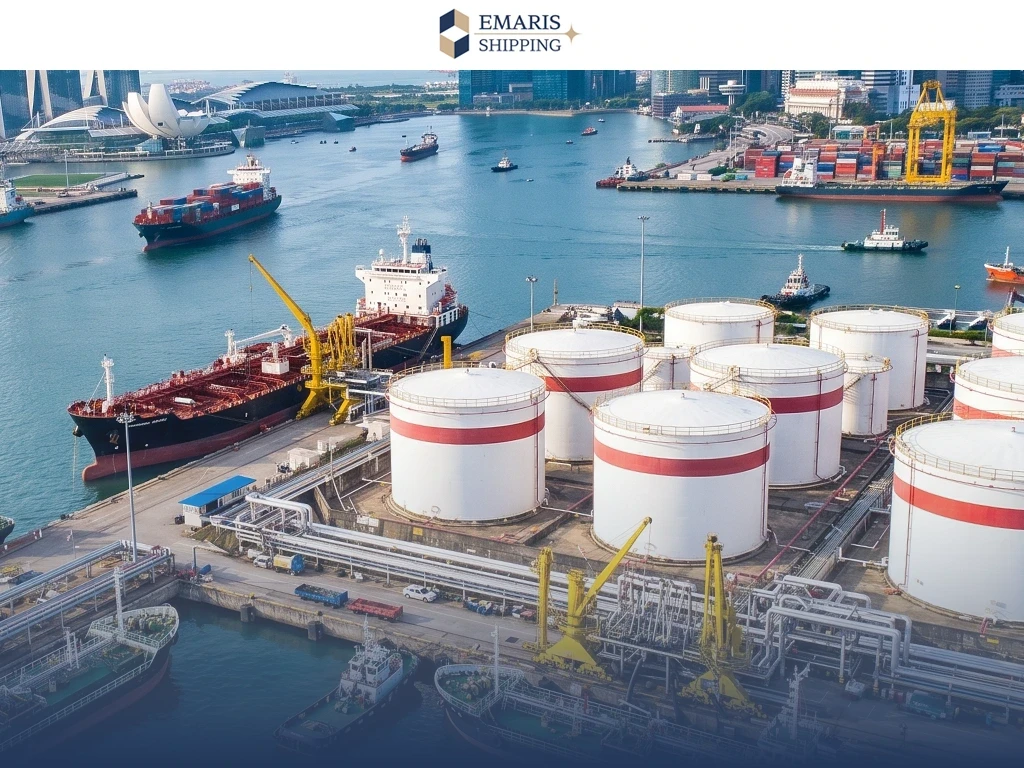
Singapore's top ship management companies are judged on the things that protect a vessel's earnings: PSC and vetting performance, ISM Code compliance depth, crew competency and retention, digital reporting transparency, and responsiveness. This overview explains those criteria and what tanker owners should check before signing.
Singapore runs the world's fourth-largest ship registry and sold a record 56.8 million tonnes of marine fuel in 2025, making it one of the most demanding operating environments for any ship management company. The city-state's concentration of maritime talent, its regulatory infrastructure under the Maritime and Port Authority (MPA), and its position as the gateway between East and West make it a natural hub for ship managers serving tanker, bulk, and bunker fleets across Asia and beyond.
But "Singapore-based" is not itself a quality signal. The range of capability among ship management companies operating out of Singapore is wide, from global operators managing hundreds of vessels to specialist providers focused on specific vessel types or trading regions. For ship owners comparing options, what matters is who delivers the operational depth, compliance rigour, and reporting transparency your fleet requires.
This overview covers how the field is evaluated, what separates high-performing operators from the rest, and why specialisation matters as much as scale when choosing a Singapore ship management partner.
Ship management companies in Singapore at a glance
Singapore's ship management companies fall into two groups: global managers that run large mixed fleets from a Singapore office, and regional specialists that focus on particular vessel types and Southeast Asian waters. The table lists established managers with a confirmed Singapore presence, what each says it focuses on, and which model it runs.
Company | Singapore presence | Stated vessel focus | Model |
|---|---|---|---|
Anglo-Eastern | Office at Labrador Tower, Pasir Panjang Road | Bulk carriers, oil and chemical tankers, container ships, gas carriers, LNG, offshore | Global |
Bernhard Schulte Shipmanagement (BSM) | Office at Bernhard Schulte House, Middle Road | Container ships, LNG, LPG, tankers, bulk carriers, offshore, cruise | Global |
Executive Ship Management | Headquartered in Singapore (Shenton Way) | All vessel types | Global |
K Marine Ship Management (K Line) | Singapore subsidiary of Kawasaki Kisen Kaisha (Keppel South Central) | Not stated on its site | Global group |
Synergy Marine Group | Headquartered in Singapore (Great World City) | Tankers, bulk carriers, container ships, LPG, LNG, offshore | Global |
V.Ships (V.Group) | V.Ships Asia Group, The Concourse, Beach Road | Tankers, bulk carriers, container ships, offshore, LNG | Global |
Wallem | Office on Robinson Road | Tankers, bulk carriers, vehicle carriers | Global |
Wilhelmsen Ship Management | Global head office in Singapore (The Concourse) | Third-party ship management | Global |
Emaris Shipping | Headquartered in Singapore (Henderson Road) | Tanker and bunker fleets | Regional: Singapore, Malaysia, Indonesia |
Listed alphabetically, with Emaris last. The table is not a ranking. Details come from each company's own website and were checked in September 2026.
The larger names bring scale in procurement, crew supply and global coverage. A regional specialist trades that scale for depth in one vessel type and one operating area. Which fits depends on your fleet, and the sections below explain how to judge that.
How We Evaluated Singapore's Ship Management Companies
The evaluation framework used here reflects the criteria that ship owners and charterers apply when assessing management quality, not fleet size alone.
Singapore's ship management market spans global operators with multi-hundred-vessel portfolios, regional specialists focused on Southeast Asian trading patterns, and sector-specific providers whose expertise is defined by vessel type rather than fleet volume.
Ranking these companies purely by fleet size misrepresents quality. A manager with 600 vessels operating across multiple sectors may deliver a less consistent inspection performance than a specialist with 60 vessels whose team has deep expertise in tanker operations and OCIMF SIRE compliance.
The factors used here to evaluate ship management quality include: Port State Control performance and detention history, SIRE vetting deficiency rates, ISM/ISPS compliance records, crew competency and retention levels, digital systems capability, financial transparency, and responsiveness to inspection findings.
Ship Management Providers in SingaporeSingapore's ship management sector includes both global operators and regional specialists, each with different value propositions for ship owners.
Global integrated managers, Larger organisations such as Synergy Marine Group, Thome Ship Management, and Bernhard Schulte Shipmanagement (BSM) operate Singapore offices as part of international networks spanning dozens of countries and thousands of managed vessels. Their strength lies in scale: global procurement networks, multinational crew pools, and standardised management systems deployed across large fleets.
Regional specialists, Smaller operators based in Singapore, focus on specific vessel types or trading regions. For tanker and bunker fleets operating primarily in the Singapore Strait, Malacca, and Indonesian waters, regional specialists often outperform global operators on inspection responsiveness, local regulatory knowledge, and crew familiarity with regional port requirements.
Sector-specific providers, Companies whose management capability is built specifically around a vessel category, chemical tankers, product tankers, bunker barges, offer depth of expertise that general managers cannot match at the same level of operational intensity.
For owners choosing between these categories, the question to ask is not "which company is largest?" but "which company's management model is built for my vessel type, my trading region, and my commercial requirements?"
What Criteria Separate the Best from the Rest
The gap between an adequate ship management company and an excellent one in Singapore comes down to five operational dimensions.
1. PSC and Vetting Performance
Port State Control detention is the most public indicator of management quality. Singapore's proximity to the Tokyo and Paris MOU inspection zones means vessels managed from here are subject to regular PSC scrutiny. The best ship management companies maintain near-zero detention records by embedding inspection preparation into daily operations, not treating it as a periodic activity.
For tanker owners, SIRE vetting deficiency rates are equally important. Charterers use SIRE scores to assess commercial risk. A management company with consistently high vetting deficiency counts directly limits the owner's ability to secure charter employment.
2. ISM Code Compliance Depth
Holding a Document of Compliance (DOC) is the minimum standard. What distinguishes better managers is the depth of their Safety Management System implementation, whether the SMS is genuinely operational onboard, not just documented ashore. Inspectors assess whether the crew can explain procedures, execute drills correctly, and produce consistent records. This is a behaviour question, not a paperwork question.
3. Crew Competency and Retention
Crew turnover is expensive and operationally disruptive. The best managers invest in career pathways, welfare programmes, and competitive conditions that retain experienced officers across contract cycles. For tanker operations specifically, where tanker endorsements, STCW requirements, and SIRE assessment of crew interaction are all commercially relevant, continuity of experienced personnel is a direct commercial asset.
4. Digital Systems and Reporting Transparency
Singapore's maritime authority has consistently driven digitalisation as a priority across the shipping sector. The best ship management companies reflect this by operating with digital compliance platforms that provide owners with live visibility into maintenance status, crew certification, PSC records, and budget performance, rather than static monthly reports.
5. Responsiveness and Accountability
How a management company responds when something goes wrong, a PSC deficiency, a SIRE observation, or an equipment failure, is as important as how they perform when things go right. Owners operating in high-scrutiny environments need managers who close findings quickly, document corrective actions thoroughly, and communicate proactively rather than reactively.
What Sets the Best Apart in Tanker and Bunker Operations
Tanker and bunker operations in Singapore carry a specific set of management demands that not all ship management companies are equipped to handle consistently.
SIRE 2.0 readiness, OCIMF's updated vetting inspection programme places greater emphasis on crew interaction, real-time evidence, and behavioural compliance than the previous paper-based model. Managers whose preparation is oriented toward documentation will underperform under this framework. Managers who have embedded SIRE 2.0 logic into operational procedures and crew training programmes will produce consistently better scores.
Bunker barge compliance, Singapore's position as the world's largest bunkering port creates a specific regulatory environment for bunker barge operators. MPA's licensing requirements, MFM (mass flow meter) regulations, and bunker surveyor interface management require specialised operational knowledge.
MPA alignment, Singapore-based managers must maintain close familiarity with MPA guidance, flag state requirements for Singapore-registered vessels, and the reporting obligations under Singapore's port state control framework. This is not administrative knowledge; it directly affects inspection outcomes for vessels calling at Singapore ports.

What Ship Owners in Singapore Get Wrong When Comparing Companies
The most common mistake in comparing Singapore ship management companies is treating fleet size as a proxy for quality. The logic appears intuitive: a manager with 600 vessels has more experience than one with 60. In practice, fleet scale and management quality are weakly correlated at the operational level that matters to individual vessel owners.
A large fleet manager with standardised procedures may excel at managing container or bulk fleets at scale, while being structurally less equipped for the inspection intensity and crew performance demands of tanker or bunker barge operations. Conversely, a specialist manager with deep domain expertise in tanker operations may deliver consistently better SIRE vetting scores and PSC outcomes precisely because their team's focus is not diluted across vessel types.
The second common mistake is selecting based on the management fee alone, without accounting for the cost of the management quality differential. A cheaper management fee that produces two PSC deficiencies and one SIRE observation per vessel per year costs more, in off-hire exposure, commercial impact, and remediation, than a slightly higher fee that delivers clean inspection performance. The economic case for quality management is measurable in the commercial record of each vessel under management.
The third mistake is not verifying inspection performance claims with evidence. Management companies can describe their inspection performance in any terms they choose in a marketing context. The right response is to request PSC detention records and SIRE observation statistics for vessels currently under their management, in the same vessel type and trading region, and evaluate the evidence, not the description.
How to Choose the Right Ship Management Company for Your Fleet
The decision framework for selecting a Singapore ship management company should be structured around your fleet's specific operational profile, not general reputation.
Step 1: Define your management scope requirements. Do you need full ship management (technical + crew + compliance) or technical management only? The answer shapes which providers are actually relevant.
Step 2: Assess inspection performance. Request PSC detention records and SIRE vetting observation rates for vessels the manager currently manages in a comparable type. Historical performance in these areas is the most reliable predictor of future performance.
Step 3: Evaluate crew management depth. For tanker operations, review the manager's officer retention rates, STCW compliance processes, and training investment levels. A manager who cannot provide these metrics clearly is not measuring them effectively.
Step 4: Review digital infrastructure. Ask how the manager provides you with live visibility into vessel operations. If the answer is a PDF report delivered monthly, the reporting infrastructure is not adequate for active fleet oversight.
Step 5: Understand the commercial model. Transparent fee structures, clearly defined scope, and defined performance KPIs in the management agreement protect your interests and create the accountability framework the relationship requires.
Why Tanker Owners Consider Emaris
For ship owners managing tanker and bunker fleets in Singapore, Malaysia, and Indonesia, Emaris Shipping offers a management model built specifically around the operational demands of this environment.
Emaris holds ISM, ISPS, MLC, Flag State, and TMSA certifications, and was the first ship management company to attain ISO 9001, ISO 14001, and ISO 45001 simultaneously, providing a quality management, environmental management, and occupational health and safety framework across all operations.
The team's background spans ISM-ISPS-MLC auditing, Flag State inspection experience, and operational leadership across oil tankers, bunker barges, container vessels, and bulk carriers. This depth is supported by the EmarisOne digital compliance platform, which connects technical management, crew performance, and inspection readiness into a single operational environment.
Explore Emaris ship management services, review the Emaris story, and see who we work with to understand the scope of vessels and owners we serve.
Frequently Asked Questions
What makes Singapore a good base for ship management? Singapore's position as a global maritime hub combines strong regulatory infrastructure under the MPA, access to a deep talent pool of maritime professionals, proximity to major regional trading routes, and established relationships with classification societies, flag state administrations, and port authorities. These factors make Singapore-based ship managers well-positioned to handle vessels operating in Southeast and East Asian markets.
How do I compare ship management companies in Singapore? Focus on PSC detention records, SIRE vetting deficiency rates, ISM audit outcomes, crew retention levels, and digital reporting capability. Fleet size is less informative than specialisation depth; a tanker-focused manager with a smaller portfolio often delivers better inspection outcomes than a generalist managing a larger fleet.
What is the difference between a global and a regional ship management company? Global managers offer scale advantages in procurement, crew supply, and international regulatory coverage. Regional managers offer depth in specific trading environments, vessel types, and local regulatory knowledge. For tanker and bunker operations concentrated in Singapore and Southeast Asia, regional specialisation often delivers more consistent inspection performance and faster operational responsiveness.
What certifications should a Singapore ship management company hold? At minimum: a valid ISM Document of Compliance, ISPS compliance certification, and MLC endorsement from the relevant flag state. Leading companies also hold TMSA certification for tanker management and additional ISO certifications for quality, environmental, and safety management systems.
Is Emaris Shipping suitable for small fleet owners? Yes. Emaris is structured to provide full management depth for owners managing one to several vessels, with the same technical, crew, compliance, and digital reporting standards applied regardless of fleet size.
External Sources