Most ship owners discover the gaps in their management company's performance during an inspection, not before one. A PSC detention, a failed vetting, an off-hire dispute, these are not sudden events. They are the visible end of a chain of untracked failures that a structured set of ship management KPIs would have surfaced months earlier.
The discipline of tracking key performance indicators across technical, crew, compliance, financial, and digital dimensions gives ship owners something more valuable than a report: it gives them early warning. And in tanker and bunker operations, where inspection standards are tight and charterer expectations are specific, that warning window is the difference between a productive quarter and a claim.
Why Ship Management KPIs Matter More Than Annual Reviews
Ship management KPIs matter because they convert operational performance into measurable, comparable data, and they do so continuously, not just at year-end reviews.
Without defined KPIs, performance discussions between owner and manager become subjective. The manager reports that "things are running well." The owner has no structured basis to agree or disagree. Problems surface only when they escalate to commercial consequences.
BIMCO, through its SHIP PI platform, has formalised 36 Key Performance Indicators for the shipping industry across technical, crew, safety, and environmental dimensions. These KPIs establish a shared language between owners and managers, one that allows performance to be benchmarked, not just described.
The categories that matter most for ship owners managing third-party ship management relationships fall across five areas: technical, crew, compliance, financial, and digital.
Technical KPIs: Measuring the Condition of Your Vessel
Technical KPIs for ship management track how effectively your manager maintains the physical condition and operational readiness of the vessel.
The most important technical indicators include:
Planned Maintenance System (PMS) completion rate
What percentage of scheduled maintenance tasks are completed on time versus overdue? BIMCO KPI036 specifically tracks overdue tasks in PMS. A consistently high overdue rate signals that the vessel is running on deferred maintenance, which accumulates risk.
Ship availability (KPI032)
The percentage of time the vessel is available for trading versus off-hire due to technical deficiencies or breakdowns. This KPI directly translates to revenue exposure.
Critical equipment failure rate (KPI012)
Frequency of failures in propulsion, steering, and safety-critical systems. These failures are costly to resolve and they attract immediate PSC and class attention.Drydocking planning performance (KPI010)
Whether drydock projects are completed on time and within the approved budget. Cost overruns and schedule slippages here signal weak planning and contractor management.
For tanker and bunker operators, technical KPI tracking is especially relevant because class societies and flag states review maintenance records during surveys and, increasingly, during vetting inspections.
Crew KPIs: Performance Starts With the People Onboard
Crew KPIs in ship management measure the human side of operational performance, the dimension most directly linked to inspection outcomes and incident risk.
Lost Time Injury Frequency (LTIF) (KPI017): The most-watched safety KPI in shipping. A rising LTIF signals deteriorating onboard safety culture, regardless of equipment condition.
Officer retention rate (KPI022): High officer turnover disrupts operational continuity, erodes institutional knowledge, and increases the cost of crew change logistics. Managers who invest in crew welfare and career development show lower turnover.
Officer experience rate (KPI023): The proportion of senior officers who meet or exceed minimum experience thresholds for the vessel type. For tanker operations, charterers explicitly assess officer experience credentials.
Training days per officer (KPI031): Whether the manager is investing in continuous competency development, not just maintaining STCW certificates at minimum standards.
Crew disciplinary frequency (KPI008): Frequency of formal disciplinary events per ship per year. A rising trend here often precedes safety incidents.
Your ship management company should be able to report these crew KPIs quarterly. If they cannot, the data infrastructure to support proactive crew management is not in place.
Compliance KPIs: Your Early Warning System for Inspections
Compliance KPIs are the most commercially sensitive metrics in ship management, because their failures are public, traceable, and directly visible to charterers and cargo interests.
Port State Control (PSC) deficiency ratio (KPI026), average number of deficiencies per PSC inspection. A low ratio demonstrates that the vessel consistently meets inspection standards, not just on good days.
PSC detention rate (KPI027), the most damaging compliance KPI. A detention removes the vessel from service, triggers mandatory follow-up inspections, and signals a systemic failure to charterers and underwriters. An effective ship management company works to keep this at zero.
Vetting deficiencies (KPI033), for tankers, OCIMF SIRE vetting scores are a commercial prerequisite. A manager with a high vetting deficiency rate directly limits the owner's chartering options.
Environmental deficiencies (KPI011), violations related to MARPOL, ballast water management, and other environmental regulations. These carry financial penalties and reputational damage in an environment of increasing charterer scrutiny around sustainability credentials.
Compliance KPIs should be reviewed after every inspection, not at quarterly reporting cycles. The pattern across inspections, not the outcome of a single event, tells the real story.
Financial KPIs: What Operational Performance Costs
Financial KPIs connect operational decisions to budget outcomes, giving owners visibility over how management decisions translate into OPEX performance.
Budget performance (KPI002): the ratio of actual expenditure to the approved OPEX budget, measured monthly and cumulatively. Consistent overspend signals poor planning or reactive maintenance. Consistent underspend may signal deferred work that will surface as a larger cost later.
Cost per running day: a normalised measure of what it costs to operate the vessel each day under management. This allows comparison across the fleet and against industry benchmarks.
Dry dock cost variance: the difference between budgeted and actual dry dock expenditure. Large variances in either direction indicate weak specification or scope management during the docking process.
For owners with multi-vessel fleets, financial KPIs become the basis for portfolio-level decisions: which vessels are underperforming against budget, and why.
Digital Monitoring: Moving KPI Tracking From Reports to Real Time
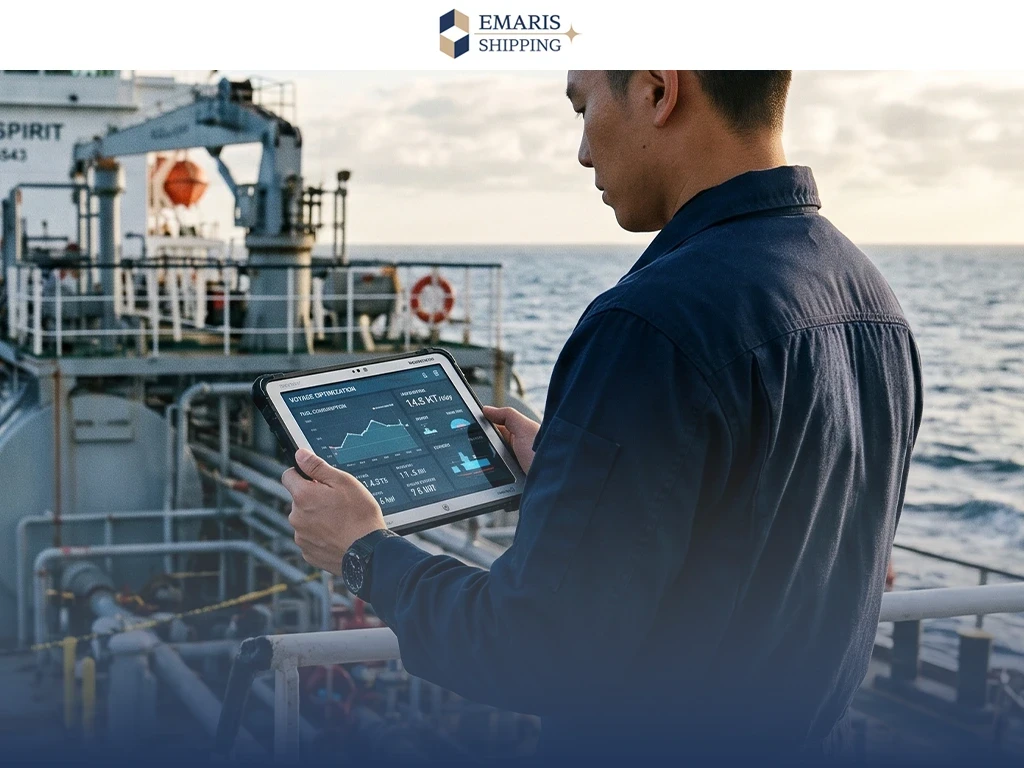
Digital monitoring changes ship management KPI tracking from a retrospective exercise into a live operational function.
Traditional reporting produces a KPI report at the end of the month. Digital platforms aggregate the same data in near-real time, allowing managers and owners to see trends forming, not just results already locked in.
The shift toward digital monitoring means that PMS overdue tasks, PSC deficiency trends, crew certification gaps, and budget variance can all be flagged before they become problems. For owners managing vessels in high-inspection environments, this is a structural advantage over competitors still relying on static monthly reports.
Emaris Shipping's digital compliance and operational systems are designed to provide this kind of live visibility, linking technical management data, crew performance, and compliance records into a single monitoring environment that owners can access directly.
How to Set Up and Review Ship Management KPIs Effectively
Setting up KPI tracking starts with the management agreement. KPIs should be defined, agreed, and included in the contract, not treated as optional reporting extras.
An effective KPI review structure typically includes:
Monthly: financial performance, PMS completion rate, crew certification status
Quarterly: technical KPI trends, PSC/vetting performance review, crew KPI benchmarking
Annually: full KPI audit, budget review, management contract performance assessment
The review process should be structured as a two-way performance conversation, not a one-way report delivery. If the manager cannot explain trends in the data, the data is not being used operationally.
Red flags in a KPI review process: metrics that only improve before the review period, explanations that consistently attribute underperformance to external factors, and an inability to provide historical trend data for benchmarking.
How Emaris Reports KPIs to Ship Owners
Emaris Shipping's approach to ship management services integrates KPI reporting as a standard output of the management relationship, not an optional add-on.
Owners under Emaris management receive structured reporting across technical, crew, compliance, and financial KPIs, supported by digital tooling that provides continuous visibility rather than static period-end summaries. For tanker and bunker operators in Singapore, where inspection pressure is consistent and charterer requirements are specific, this reporting structure is part of operational risk management, not administrative overhead.
The EmarisOne platform underpins this by aggregating vessel data, maintenance records, and compliance status into a format that supports both daily management decisions and owner-level oversight.
Frequently Asked Questions
What are the most important KPIs for ship management? The most critical ship management KPIs are PSC detention rate, PMS completion rate, ship availability, LTIF, officer retention rate, and budget performance. These five cover the dimensions, compliance, technical, safety, crew, and financial, that most directly affect operational outcomes and commercial performance.
How often should ship management KPIs be reviewed? Financial and maintenance KPIs should be reviewed monthly. Compliance and crew KPIs should be reviewed after every inspection event and quarterly in aggregate. A full KPI audit should be conducted annually and tied to the management contract review cycle.
What does BIMCO SHIP PI measure? BIMCO SHIP PI Version 4.0 defines 36 Key Performance Indicators across safety, technical, crew, environmental, and operational dimensions. It provides a standardised framework that allows ship managers and owners to benchmark vessel performance against industry norms across vessel types.
Can KPIs be included in a ship management contract? Yes, and they should be. Performance KPIs should be explicitly defined in the management agreement, with reporting obligations, review frequency, and performance thresholds specified. This transforms KPIs from informational metrics into contractual accountability mechanisms.
What happens if a ship management company can't provide KPI data? If a manager cannot provide structured KPI reporting across technical, crew, compliance, and financial dimensions, it indicates that the digital and operational infrastructure for proactive management is not in place. This is a significant risk factor, particularly for tanker owners operating in vetting-intensive commercial environments.
External Sources